


I’ve sat across from CEOs, nurses, attorneys, parents, and business owners who whisper the same sentence in different ways:
“I’m not failing. But I’m not okay.”
They’ve kept the job. Paid the mortgage. Showed up to birthday parties. And somewhere along the way, pills stopped being a solution and started being a secret.
If you’re quietly looking into support for opiate use, I want to tell you what I hear most often before someone finally walks through our doors.
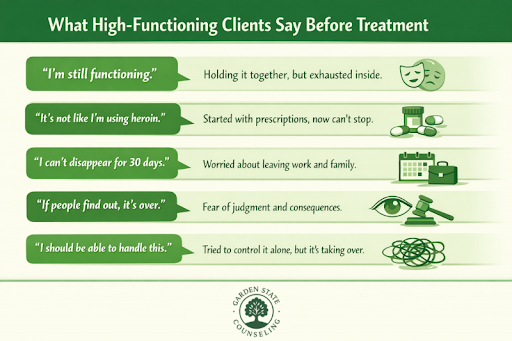
“I’m still functioning.”
Yes. You are.
You’re answering emails. You’re closing deals. You’re getting your kids to practice. On the outside, your life still looks intact.
But functioning isn’t the same as living.
When you tell me you’re functioning, what I often hear underneath is this:
“I’m exhausted from holding this together.”
High-functioning clients don’t crash publicly. They erode privately.
“It’s not like I’m using heroin.”
This one comes up quietly. Almost defensively.
For many professionals, it started with prescriptions. A back injury. Surgery. Long hours. Then stress. Then needing a little more to feel normal.
You don’t see yourself in the stereotypes. You don’t identify with “addict.” You just know you can’t get through a week without counting pills.
Addiction doesn’t care about your résumé. It only cares about repetition.
And if you’ve started researching Opiate Addiction Treatment, it’s probably because repetition has turned into dependence.
“I can’t disappear for 30 days.”
Most high-achieving people believe treatment means vanishing from life.
That fear keeps them stuck longer than anything else.
Here’s what I tell them: not everyone needs to leave their job or their family for a month. There are structured daytime and multi-day weekly options that allow you to get real help without burning your life down to do it.
The right level of care fits your life, it doesn’t punish you for having one.
If you’re exploring care in New Jersey, there are options that respect your responsibilities while still taking your health seriously.
“If people find out, it’s over.”
This one carries the most weight.
Doctors worry about licenses. Executives worry about boards. Parents worry about judgment. Everyone worries about reputation.
But here’s what I’ve seen over and over:
The damage from untreated addiction is far greater than the discomfort of asking for help.
Secrecy feels protective.
It’s actually corrosive.
The professionals who come in terrified of being “found out” often leave relieved that they don’t have to lie anymore.
“I should be able to handle this.”
High-functioning clients are problem-solvers. You fix things. You push through. You outperform stress.
So when opiates stop being optional and start being necessary, your first instinct isn’t to ask for help. It’s to optimize.
Cut back. Switch brands. Schedule doses. Hide it better.
But addiction is the one problem that gets worse the more you try to manage it alone.
You’re not weak because this outpaced you.
You’re human.
What I See After They Say Yes
The first week isn’t dramatic. It’s quieter than people expect.
They sleep.
They exhale.
They stop performing.
And slowly, the edge that felt like “success” starts to look more like chronic stress and chemical dependency.
High-functioning clients often discover something surprising: they weren’t afraid of treatment. They were afraid of slowing down long enough to feel what was underneath.
When they do, it’s not catastrophic. It’s relieving.
If you’re reading this and recognizing yourself, you don’t have to hit a public rock bottom to justify getting help.
You’re allowed to choose stability before collapse.
You’re allowed to want your mind back.
You’re allowed to step into Opiate Addiction Treatment before your career, your health, or your family forces the decision for you.
If you’re looking for treatment options in Helps You Grow Again, know that quiet, professional, confidential care exists and it’s designed for people exactly like you.
You don’t have to blow up your life to save it.
Call 201-632-5716 or visit our opiate addiction treatment services to learn more about our Opiate Addiction Treatment services in New Jersey.