


I’ve sat across from artists, entrepreneurs, musicians, parents—the life of the party types—and heard the same quiet fear:
“What if I get sober and I’m not… me anymore?”
Before we talk about anything else, I want you to know: that fear makes sense. And if you’re considering opiate addiction treatment, it’s one of the most human questions you can ask.
“What If I Get Boring?”
Let’s name it directly.
You’re not just afraid of losing a substance.
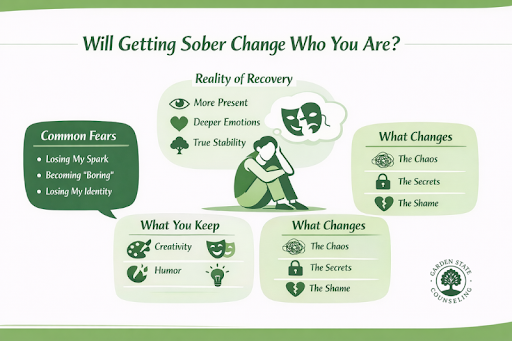
You’re afraid of losing your spark.
Maybe using has been woven into your creativity. Your social life. Your ability to feel things fully. Maybe it helped you write, perform, connect, or soften the edges of anxiety in rooms that felt overwhelming.
I’ve had clients tell me, “I don’t want to become beige.”
That’s not shallow. That’s identity.
What Substances Gave You (And Why That Matters)
As a clinician, I don’t dismiss what substances did for you.
For many people, they:
- Turned down social fear
- Turned up emotion
- Made connection feel easier
- Opened creative channels
- Offered relief from mental noise
We can’t ignore that. Recovery isn’t pretending those benefits never existed.
But here’s what I often help people explore:
Were those qualities created by the substance—or uncovered temporarily?
There’s a difference.
The Myth of the “Flattened” Sober Person
Some people imagine recovery as gray. Quiet. Restrained.
In reality, what I see in long-term healing is depth.
When someone steps into structured support for opioid use, they don’t become less. They become more stable. More intentional. More present.
Early sobriety can feel unfamiliar. Emotions come back online. Social settings feel different. Your brain recalibrates.
That adjustment period can be mistaken for personality loss.
It’s not loss. It’s healing.
You Don’t Lose Your Identity, You Separate It
Addiction is adhesive. It sticks itself to your personality and whispers, “This is you.”
But over time, we start gently separating:
- You from the coping strategy
- You from the chemistry
- You from the fear
In opiate addiction treatment, much of the work isn’t about erasing who you are.
It’s about rediscovering who you were before survival took over.
One client once told me, months into recovery,
“I thought I’d lose my edge. Turns out, I just lost my chaos.”
There’s a difference.
Creativity, Charisma, and Emotional Depth in Recovery
This is the part many people don’t hear enough:
Creativity does not disappear in sobriety.
Charisma does not evaporate.
Emotion does not flatten.
In fact, when your nervous system isn’t riding waves of intoxication and withdrawal, your access to those parts often becomes steadier.
More reliable.
Less expensive.
And if underlying anxiety or depression surfaces, that’s not a failure, it’s information. There are real treatment options in New Jersey that support both emotional health and substance recovery without erasing identity.
You are not required to choose between being well and being yourself.
What Actually Changes
Here’s what I do see change:
- The frantic edge
- The secret-keeping
- The shame spiral
- The physical dependence
- The fear of being found out
What tends to stay?
- Humor
- Talent
- Sensitivity
- Insight
- The core temperament that has always been yours
Sobriety doesn’t hand you a new personality.
It gives your real one a chance to breathe.
If You’re Standing at the Edge of This Decision
If part of you wants help but another part is afraid of disappearing, I hope you pause here.
You are not weak for wanting relief.
You are not dramatic for loving your identity.
You are not foolish for being afraid.
You deserve support in figuring this out thoughtfully.
At Garden State Counseling Center, we approach healing with respect for the whole person—not just the behavior. If you’re exploring next steps, you can learn more about our approach to care and find compassionate support in New Jersey that honors who you are.
Call (201) 632-5716 or visit our Opiate Addiction Treatment services in New Jersey to learn more about our Opiate Addiction Treatment services in New Jersey.
You don’t have to become someone else to get better.
You just have to give yourself the chance to come back.