


You thought the worst was behind you.
And now you’re watching the signs creep back in.
As a clinician — and as someone who has sat with many parents in your exact chair, I want you to hear this first: this is heartbreaking. And it does not mean you failed.
If you’re looking into options like alcohol addiction treatment, you’re probably realizing something important: this isn’t just about drinking. It never was.
It’s Rarely Just About Alcohol
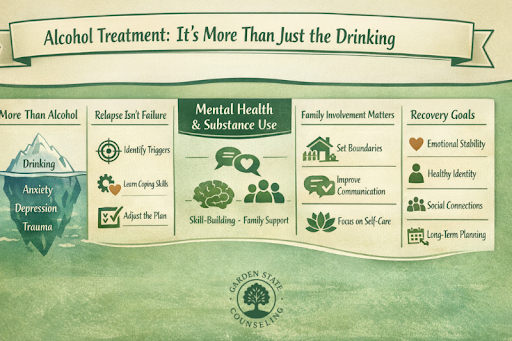
Alcohol is often the visible symptom. The iceberg is underneath.
For many young adults, drinking is tangled up with:
- Anxiety that never shuts off
- Depression that feels heavy and quiet
- Social pressure they don’t know how to navigate
- Trauma they’ve never fully processed
- A sense of not being enough
When a 20-year-old starts using again, it’s often because the pain underneath resurfaced and alcohol still feels like the fastest relief.
The goal isn’t just to remove the drink. It’s to understand what the drink was doing for them.
Relapse Doesn’t Erase Progress
This is the part parents struggle with the most.
You watched them complete treatment. You saw glimmers of hope. Maybe even laughter.
Now it feels like starting over.
But clinically? We don’t see relapse as erasing growth. We see it as information.
It tells us:
- What triggers weren’t fully addressed
- What coping tools weren’t strong enough yet
- What emotional wounds still need attention
Recovery isn’t linear. It’s developmental. Especially at 20, when identity, independence, and mental health are still forming.
Good Care Looks at Mental Health and Substance Use Together
When mental health and substance use collide, treating only one rarely works.
A young adult might say, “I’m fine,” while quietly battling:
- Panic attacks
- Shame
- Sleep disruption
- Academic or career pressure
- Relationship instability
If the anxiety stays untreated, alcohol becomes the coping strategy again.
Effective support integrates therapy, skill-building, family involvement when appropriate, and a pace that matches their stage of life. Sometimes that’s structured daytime care. Sometimes it’s multi-day weekly treatment. Sometimes it’s deeper stabilization first.
It’s not one-size-fits-all. And it shouldn’t be.
If depression is part of the picture, for example, families often benefit from exploring options for help in New Jersey that address both mood and substance use not one in isolation.
Family Work Matters Without Blame
Parents often whisper this to me:
“Did I cause this?”
Addiction is complex. Biology, environment, temperament, trauma, they all play roles. Love is not the cause.
But family support is part of healing.
That doesn’t mean fixing everything for them. It means:
- Learning healthy boundaries
- Shifting communication patterns
- Reducing rescue behaviors
- Strengthening your own support system
You can love your child fiercely and still stop cushioning every fall. That balance is hard. It’s also powerful.
What Comprehensive Support Actually Changes
When care is done well, it addresses:
- Emotional regulation (how to sit with discomfort without escaping)
- Identity development (who am I without alcohol?)
- Peer influence and social confidence
- Accountability without shame
- Long-term relapse prevention planning
It helps your child build a life where alcohol isn’t the main coping tool.
And it helps you exhale not because everything is perfect, but because there’s a plan.
You Are Not Out of Options
It can feel like the door is closing.
It isn’t.
Young adults relapse. They resist. They push back. And many of them still recover sometimes stronger the second time, because they better understand what they’re up against.
If you’re considering alcohol addiction treatment, the next step doesn’t have to be dramatic. It can be a conversation. A consultation. A reassessment of what wasn’t fully addressed before.
If you’re looking for steady, grounded support in Helps You Grow Again, there are professionals who understand both the heartbreak and the clinical reality of this stage.
You don’t have to carry this alone.
Call (201) 632-5716 or visit our alcohol addiction treatment services to learn more about our alcohol addiction treatment services.