


I remember sitting in my car after treatment, staring at the steering wheel, thinking: That was it? That’s what was supposed to fix me?
I had technically completed a round of opiate addiction treatment. I went to groups. I nodded at the right times. I even said some honest things.
And still, I relapsed.
For a long time, I told myself it didn’t work.
Now I see it differently.
I Thought Treatment Was Supposed to “Cure” Me
No one said that out loud. But that’s what I expected.
I wanted the obsession gone. I wanted to wake up and feel normal. I wanted the volume in my head turned down to zero.
When that didn’t happen immediately, I decided the program failed.
What I didn’t understand then is this: treatment doesn’t erase your past or magically rewire your brain in 30 days. It gives you structure, tools, and a different way to respond when the craving hits.
I was waiting to feel different. I didn’t realize I had to start acting differently first.
I Confused Discomfort With Failure
Early recovery is uncomfortable. There’s no way around it.
You’re sitting in your own thoughts without the one thing that used to quiet them. You’re learning how to feel again. You’re sleeping differently. Eating differently. Thinking differently.
I thought the anxiety meant I was broken.
It didn’t. It meant I was detoxing emotionally.
What makes recovery stick isn’t the absence of discomfort. It’s learning not to run from it.
I Wasn’t Honest About What Was Actually Driving Me
In my first round of care, I talked about using.
I didn’t talk about shame. Or the panic I carried since I was a teenager. Or how exhausted I was trying to look okay all the time.
When mental health and substance use collide, it’s not enough to just remove the substance. You have to address what it was helping you avoid.
The second time I got help, I was more honest. That changed everything.
The Structure Mattered More Than I Wanted to Admit
I used to roll my eyes at schedules.
Group at 9. Individual sessions. Check-ins. Accountability.
Now I understand why structured daytime care and multi-day weekly treatment exist. Not to control you. To stabilize you.
When your brain has been living in chaos, structure feels foreign. But it’s also what creates safety.
Consistency gave my nervous system a chance to calm down. That’s when things finally started to click.
I Had to Stop Looking for Proof It Wouldn’t Work
This one’s hard to admit.
Part of me went into my first experience already skeptical. I was scanning for confirmation: See? This is pointless. These people don’t get me.
If you’re reading this thinking, “I already tried. Why would this be any different?”, I get it.
But sometimes the difference isn’t the building. It’s the willingness.
The second time, I didn’t demand guarantees. I just stayed. Even on the days I wanted to disappear.
That’s when change started showing up quietly.
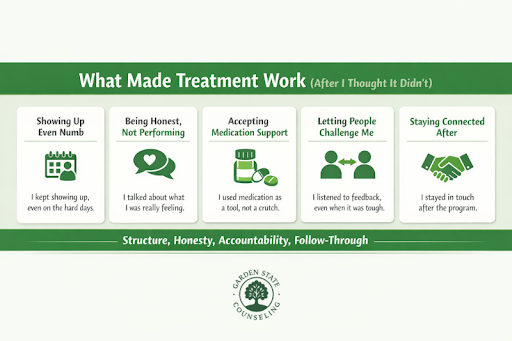
What Actually Made It Work
It wasn’t a single breakthrough moment.
It was:
- Showing up even when I felt numb
- Being honest when it would’ve been easier to perform
- Accepting medication support instead of seeing it as weakness
- Letting people challenge me
- Staying connected after the formal program ended
And yes, eventually returning to a different kind of opiate addiction treatment with more openness than I had before.
That combination – structure, honesty, accountability, and follow-through—is what stuck.
Not hype. Not promises. Practice.
If You’re Skeptical Right Now
You’re not wrong for feeling disappointed.
Not every program is the right fit. Not every phase of your life makes you ready to receive help.
But “it didn’t work” and “it didn’t work that time” are two very different sentences.
If you’re in New Jersey and even a small part of you is willing to revisit the idea, there are thoughtful, grounded treatment options in New Jersey that look at the full picture, not just the substance, but the stress, trauma, and mental health underneath it.
You don’t have to fake optimism. You just have to be open enough to try differently.
If you’re considering taking another look, Call (201) 632-5716 or visit our opiate addiction treatment services to learn more about our Opiate Addiction Treatment services in New Jersey.