


You already know it’s time.
Maybe you’re tired of waking up anxious about what you said. Maybe your body feels worn down. Maybe you’ve tried to stop on your own and it didn’t stick.
If you’re looking into alcohol addiction treatment, the biggest question is usually this: What actually happens? And where do I fit in?
Let’s slow it down.
It Usually Starts with Safety
If your body has become physically dependent on alcohol, stopping suddenly can feel scary and sometimes unsafe.
The first step for many people is detox. This is short-term medical support to help your body stabilize. It’s not a test of willpower. It’s not punishment.
It’s a soft landing for your nervous system.
Not everyone needs this level of care. But if you do, it’s there to protect you—not judge you.
When You Need Distance from Your Old Patterns
Some people benefit from live-in treatment or round-the-clock support after detox.
Why?
Because early recovery can feel loud. Cravings. Emotions. Regret. Fear. Being in a space away from daily triggers where your only job is to focus on healing, can create breathing room.
You don’t have to perform strength there. You just have to show up.
Structured Daytime Care (Without Living On-Site)
Others step into structured daytime care instead.
This level offers multiple hours of therapy and support during the day, but you return home at night. It’s often helpful if you need strong structure but also have responsibilities you can’t fully step away from.
Think of it as scaffolding while you rebuild.
You’re supported but still practicing real life.
Multi-Day Weekly Treatment That Fits Real Life
As stability grows, some people move into multi-day weekly treatment.
This option provides several sessions per week, group, individual, and skill-building but leaves space for work, family, and rebuilding routines.
It’s not “less serious.” It’s just a different intensity.
Recovery isn’t one-size-fits-all. It adjusts as you do.
You Don’t Have to Figure Out the Level Alone
One of the biggest fears we hear is:
“What if I pick the wrong one?”
You won’t be expected to guess.
When someone reaches out to Garden State Counseling Center, we assess what’s medically appropriate, emotionally realistic, and logistically possible. Your history matters. Your mental health matters. Your daily life matters.
If depression, anxiety, or trauma are part of the picture which they often are those get addressed too. You can explore integrated support in New Jersey through our broader support in New Jersey services as part of your healing plan.
You’re not a category. You’re a person.
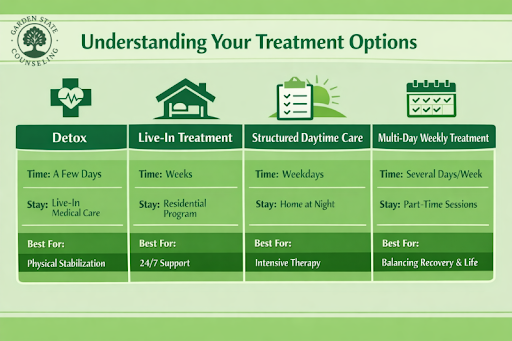
A Quick Look at How Levels of Care Differ
| Level of Support | Time Commitment | Living at the Facility? | Best For |
| Detox | Short-term (days) | Yes (medical setting) | Physical stabilization |
| Live-in treatment | Weeks | Yes | High structure + trigger-free space |
| Structured daytime care | Most weekdays | No | Strong support + home at night |
| Multi-day weekly treatment | Several days/week | No | Continued recovery while rebuilding life |
Movement between levels is normal. It’s not failure. It’s responsiveness.
The Goal Isn’t to “Complete” Treatment
It’s to return to yourself.
That might mean sleeping through the night. Laughing without a drink in your hand. Having a hard conversation without spiraling.
Treatment is structured because early recovery needs structure. But the purpose isn’t control.
It’s freedom.
If you’re scared you won’t be able to do it, say that out loud. We’ve heard it before. And we’ve watched people do this anyway.
You deserve steady, stigma-free help in Helps You Grow Again, and you deserve to know your options before taking the first step.
You don’t have to commit to forever. You just have to be willing to begin.
Call 201-632-5716 or visit our alcohol addiction treatment services in to learn more about our alcohol addiction treatment services in New Jersey.