



I remember sitting in my car after my relapse, staring at the steering wheel like it had answers.
Ninety-two days sober. Gone.
At least that’s what I told myself.
The truth? The tools I learned during alcohol addiction treatment didn’t disappear.
I just stopped using them.
And that’s different.
I Didn’t “Forget” What I Learned
I knew how to call someone before picking up.
I knew how to leave the room.
I knew how to say, “I’m not okay.”
But knowing and doing aren’t the same thing.
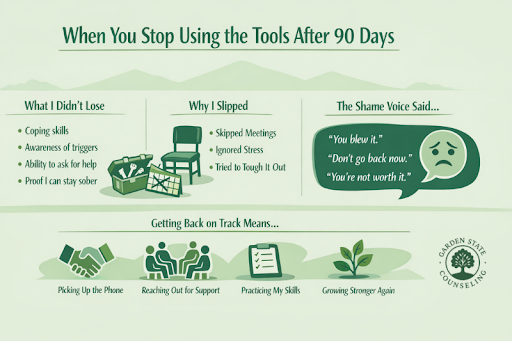
Relapse didn’t happen because treatment failed. It happened because I drifted. I skipped meetings. I stopped being honest about stress. I convinced myself I was strong enough to white-knuckle it.
Looking back, there was a quiet post-recovery emotional distance that crept in — subtle at first, but enough to disconnect me from the support I once relied on.
I had the tools. I put them back in the drawer.
The Shame Was Louder Than the Slip
The drink wasn’t even the worst part.
The shame was.
That voice that said: You had your chance. You blew it. Don’t embarrass yourself by going back.
If you’re there right now, hear me: that voice is not wisdom. It’s fear wearing your face.
Relapse after 90 days doesn’t mean you’re back at day one as a human being. It means something stopped working and that’s worth looking at, not hiding from.
What I Actually Lost (And What I Didn’t)
I lost momentum.
I lost some trust with people I care about.
I lost the illusion that I could coast.
But I didn’t lose:
- The coping skills I practiced
- The awareness of my triggers
- The ability to ask for help
- The proof that I can stay sober
That last one matters more than you think.
You stayed sober for 90 days. That’s not erased. That’s evidence.
The Tools Only Work If You Keep Touching Them
Here’s the spicy part nobody likes to say out loud:
Sobriety isn’t maintained by what you learned.
It’s maintained by what you practice.
Treatment gave me structure, check-ins, group accountability, and daily reflection. When I left, I quietly decided I didn’t need as much support.
That decision didn’t explode overnight. It faded. One skipped call. One lie by omission. One stressful week I handled “on my own.”
Recovery isn’t a diploma you frame.
It’s a muscle you use.
When I stopped using it, it got weak.
Going Back Wasn’t a Walk of Shame
Walking back into care felt like showing up to class after missing a final exam.
I expected side-eyes. Disappointment. A lecture.
What I got was: “We’re glad you’re here.”
No drama. No shaming. Just people who understood that relapse is part of many recovery stories not the end of them.
Re-engaging in support, even structured daytime or multi-day weekly care again, wasn’t regression. It was repair.
If you’re in New Jersey and wondering whether you have to start over completely, you don’t. There are real, grounded treatment options in New Jersey that meet you where you are not where you “should” be.
If You’re Sitting in Your Car Right Now
Maybe you haven’t told anyone yet.
Maybe you’re trying to “fix it” quietly before it becomes real.
I did that too.
Here’s what I wish someone had said to me:
You are not disqualified.
You are not a fraud.
You are not harder to help now.
You just stopped using the tools.
And tools can be picked back up.
Garden State Counseling Center offers steady, grounded support if you’re ready to re-engage with alcohol addiction treatment in a way that actually fits your life now not the version of you from three months ago.
Call 201-632-5716 or visit our alcohol addiction treatment services to learn more about our alcohol addiction treatment services in New Jersey.
And if all you can do today is admit, “I need help again,” that’s not failure.
That’s strength returning.