


You didn’t imagine this for your child.
And you definitely didn’t imagine Googling at 2 a.m., trying to figure out whether this is “a phase” or something far more serious.
If you’re here, something in your gut is telling you this isn’t just recreational anymore. It may be time to look at real opiate addiction treatment. And even typing those words can feel like admitting something terrifying.
Let’s slow this down together.
When “Concern” Turns Into Urgency
There’s a difference between worry and alarm.
Worry says, “I don’t like what I’m seeing.”
Alarm says, “Something is very wrong.”
Urgency often shows up quietly at first:
- You’re checking their breathing when they sleep.
- You’re scanning their mood for signs of withdrawal.
- You’re bracing every time the phone rings.
If your nervous system hasn’t felt calm in weeks, that matters.
As a facility, we’ve walked alongside many families at this exact moment. The moment when love is still strong but control is gone.
Signs This Isn’t Something They Can “Outgrow”
You may have already tried:
- Conversations
- Boundaries
- Threats
- Financial cutoffs
- Pleading
And still, the behavior continues.
When opioid use escalates, it rarely stabilizes on its own. Tolerance builds. Risk increases. What once “took the edge off” can start taking over everything, sleep, relationships, health, safety.
You are not overreacting if you’re afraid.
Fear, in this case, is information.
The Myth That Waiting Will Make It Clearer
Many parents tell us they waited because they hoped things would get obvious.
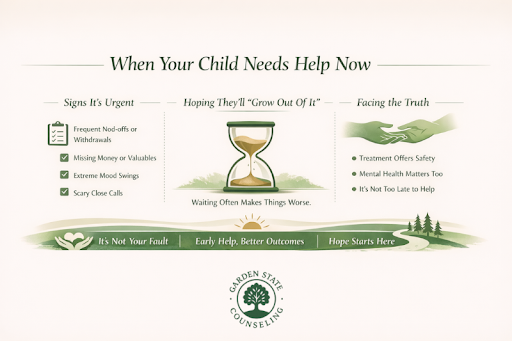
But opioid misuse doesn’t always come with dramatic scenes. Sometimes it looks like:
- A once-motivated student who stops showing up
- A young adult who isolates and sleeps all day
- Money disappearing
- Mood swings that feel extreme and unfamiliar
You don’t need proof of rock bottom to take action.
Early intervention is not overstepping. It’s protecting.
What Treatment Really Means for a Young Adult
This is where parents often freeze.
You might picture something harsh or institutional. You might worry your child will feel punished.
That’s not the goal.
Effective support is structured, consistent, and built around safety. Sometimes that means structured daytime care. Sometimes it’s multi-day weekly treatment. Sometimes it requires more intensive, round-the-clock support for a period of time.
The right level depends on how severe the situation is not on shame, not on appearances.
At Garden State Counseling Center, our approach to Opiate Addiction Treatment focuses on stabilization first. Safety first. Dignity always.
Because your child is not their worst week.
When Mental Health and Substance Use Collide
For many young adults, opioid use doesn’t exist in isolation.
Anxiety. Depression. Trauma. Unresolved pain.
Sometimes substances begin as relief and end as a trap.
When mental health and substance use collide, things can unravel quickly.
If your child is also struggling emotionally, seeking comprehensive care in New Jersey that addresses both pieces together can make the difference between temporary stabilization and real progress.
You don’t have to untangle that complexity alone. That’s our job.
You Are Not Failing Them
Parents often whisper the same sentence to us:
“I should have seen this sooner.”
Maybe. Maybe not.
Addiction is skilled at hiding. Young adults are skilled at minimizing. And loving parents are skilled at hoping.
None of that makes you negligent.
It makes you human.
There is still time to step in. There is still time to shift the trajectory.
Sometimes urgency isn’t a sign you’ve failed.
It’s a sign you’re ready to act.
If you’re looking for care in New Jersey and need clarity about next steps, you don’t have to figure it out alone.
Call (201) 632 5716 or visit our Opiate Addiction Treatment services to learn more about our Opiate Addiction Treatment services in New Jersey.