



I didn’t walk into CBT with high hopes.
I’d already tried therapy—more than once. I sat on the couch, opened up, answered questions, journaled, even tried to feel something when I was supposed to. I followed the steps. And still, nothing really shifted.
So when someone suggested CBT, I rolled my eyes.
But here’s what surprised me: Cognitive Behavioral Therapy didn’t require me to believe it would work. It didn’t care if I was hopeful. It just gave me tools—real, practical ones—that started working before I was convinced.
If you’ve been burned by therapy, disappointed by progress that never came, or tired of being told to “keep trying,” CBT might still be worth your time.
At Garden State Counseling Center, we offer CBT therapy in Paramus, New Jersey for people like us—the ones who are skeptical, cautious, or just flat-out done hoping.
CBT Works With What You’re Feeling Right Now
CBT isn’t about dissecting your childhood (unless that’s where you want to go). It doesn’t force you to relive trauma or analyze your dreams.
Instead, CBT starts with your present patterns:
- What thoughts pop into your head when things go wrong?
- How do you react to stress, criticism, or failure?
- What do you believe about yourself—and what does that belief push you to do?
For me, CBT started with one thought I had every time I made a mistake: “Of course I messed that up.” I didn’t even notice it—it was automatic. CBT helped me catch that moment and ask, Wait—is that actually true?
It’s not about pretending everything’s fine. It’s about pausing the spiral before it drags you deeper.
You Can Doubt It and Still Make Progress
This is one of the most important things I learned: you don’t have to believe in CBT for it to help.
I was fully skeptical when I started. I told my therapist straight out, “I’ve done this before. It didn’t help.”
She nodded and said, “That’s fair. Let’s look at why.”
No defensiveness. No pressure. Just a calm conversation about what worked, what didn’t, and what I actually needed this time around.
We found a way in. Slowly. CBT gave me space to experiment with tools and drop the ones that didn’t land. That’s the beauty of it—it’s adaptable. It’s not one-size-fits-all. It’s more like trying on a jacket, seeing how it fits, and tailoring it if needed.
The Tools Are Simple—But They’re Not Shallow
CBT tools aren’t profound in the traditional sense. You won’t leave a session feeling like your entire worldview has shifted. But that’s kind of the point.
You’re not looking for magic. You’re looking for something that actually helps on Tuesday morning when you don’t want to get out of bed.
CBT gave me tools like:
- Thought tracking (yes, literally writing down the unspoken stuff in my head)
- Cognitive reframing (not toxic positivity—just adjusting the lens)
- Behavior experiments (trying small, low-stakes actions and seeing what happened)
- Exposure planning (gently facing things I usually avoided instead of avoiding them forever)
These tools didn’t cure me. But they gave me traction—and when you’re stuck, traction is everything.
Progress Isn’t Always Obvious—But It Builds
There were weeks I showed up to therapy with nothing new to say. Same spiral. Same overthinking. Same tired story.
And yet, things were changing.
I stopped assuming every silence meant rejection.
I started noticing when guilt wasn’t actually mine to carry.
I said “no” once—to a favor I didn’t have the energy for—and didn’t apologize for it.
It’s slow. Quiet. Almost boring, until it isn’t.
CBT helped me realize that progress isn’t loud. It doesn’t come in breakthroughs. It comes in micro-movements—the kind that add up over time.
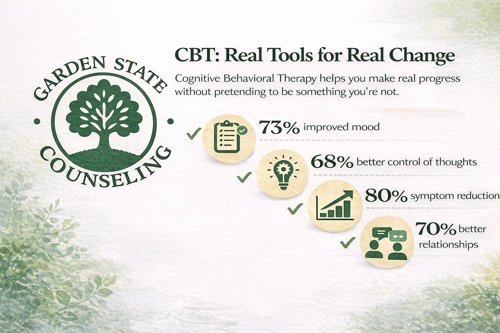
Good CBT Doesn’t Judge You for Showing Up Messy
CBT isn’t a performance.
There were weeks I didn’t do the worksheet. Weeks I brought in a crumpled note on my phone instead of the assignment. Weeks I said, “This feels like crap and I’m not doing it.”
A good CBT therapist won’t shame you for that.
At Garden State Counseling Center—and if you’re looking for CBT in Hackensack or nearby—the CBT providers know that real life doesn’t follow a treatment plan. They’ll work with what you can give, not what you “should” be doing.
You Don’t Have to Want to Talk About Everything
Here’s something I wish someone had told me sooner: CBT doesn’t require emotional excavation.
If you’ve had experiences with therapy where you felt pushed to talk about trauma before you were ready—or like you were “failing” therapy for keeping things surface level—CBT is a relief.
You don’t have to cry to prove it’s working.
You don’t have to tell your life story.
You don’t have to explain every bad day.
You just have to be willing to look at what your mind is doing, and how that’s showing up in your behavior—and try small, specific shifts.
That’s it.
CBT Helped Me Stop Making Bad Days Worse
The most honest thing I can say? CBT didn’t make my pain disappear. But it helped me stop adding more pain on top of it.
Before CBT, a hard morning could derail my entire week. One critical comment could ruin a relationship. One anxious thought could make me cancel everything.
CBT didn’t remove those triggers. But it helped me pause.
Instead of “I’m spiraling, screw it,” I could say, “I know this pattern. I’ve seen it before. I can do one small thing differently right now.”
That’s how CBT works: not by erasing your stuff—but by helping you not get swallowed by it.
FAQs: Honest Answers for People Who Don’t Buy the Hype
What’s different about CBT compared to regular talk therapy?
CBT is structured. You work on current problems, not just past stories. And you get skills you can use between sessions—not just insight in the room.
What if I’ve done CBT before and it didn’t help?
That’s fair. Not all therapists deliver CBT well. Sometimes the timing’s off. That doesn’t mean you can’t benefit—it means it’s worth trying a new version, with better fit and pacing.
Is CBT just “think positive”?
No. CBT doesn’t sugarcoat your thoughts. It challenges unhelpful ones and helps you test new perspectives—without faking anything.
How long does CBT take to work?
Most people notice small changes in 4–8 sessions. Real growth often takes longer. But CBT is goal-oriented and usually shorter-term than other therapies.
Do I have to do homework?
Usually, yes—but it’s not school. It’s small tasks that reinforce what you’re learning. And if it’s not working for you, your therapist will adjust.
You Don’t Have to Fake Hope. Just Start from Here.
If you’re tired of people telling you to “just try therapy again,” I get it.
This isn’t about hype. It’s about options. About finding one approach that doesn’t waste your time, talk over your experience, or try to sell you on a miracle.
CBT won’t change who you are. It just gives you back a little more control—and for many of us, that’s enough.
To explore our CBT services in Paramus, New Jersey, you don’t need to commit. You just need to be curious.
Call (201) 632 5716 to learn more about our Cognitive Behavioral Therapy in Paramus, New Jersey. No pressure. No lectures. Just space to try again—with something that might actually work this time.