



I had 90 days. I remember the number because it felt like proof.
Proof I wasn’t who I used to be.
And then I lost it.
Somewhere between “I’ve got this” and “just this once,” I slipped. And the hardest part wasn’t the relapse—it was what came after.
The Part Nobody Talks About: What Happens After You Fall
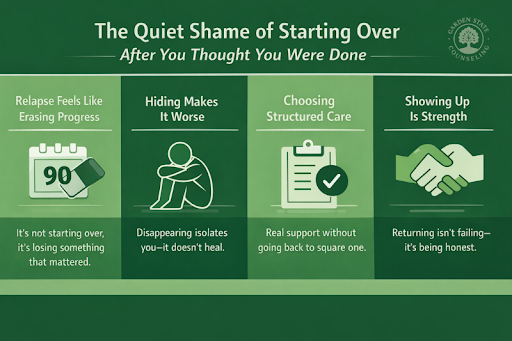
Relapsing after some clean time doesn’t feel like starting over.
It feels like erasing something that mattered.
I didn’t want to tell anyone. Not my friends, not my family—definitely not the people who had seen me doing well. The voice in my head was loud:
“You already proved you can’t hold onto this.”
That voice almost kept me from coming back.
Why Disappearing Feels Easier Than Reaching Out
There’s a moment after a relapse where you decide what kind of story this becomes.
For me, disappearing felt safer. No questions. No disappointment. No having to explain how I went from “doing great” to right back where I started.
But here’s the truth I didn’t want to accept:
Disappearing doesn’t protect you—it just isolates you long enough to get worse.
The Question That Changed My Direction
At some point, I stopped asking, “Why did I mess this up?”
And started asking something different:
“What kind of support do I actually need this time?”
Because what worked at the beginning didn’t necessarily match where I was now.
I wasn’t new anymore. I understood the basics.
But I also knew I needed more structure than I was giving myself.
That’s when I started looking into different levels of care again—and trying to understand things like day treatment vs inpatient without the pressure of “getting it perfect.”
Why I Chose Structured Daytime Care Instead of Going All In Again
Going back to full-time, live-in treatment didn’t feel right for me this time.
Not because it doesn’t work—it absolutely does. But I needed something that let me stay connected to real life while still having serious support.
Structured daytime care gave me that middle ground.
- I wasn’t alone all day
- I had accountability again
- I could process what actually led to my relapse—not just avoid it
Most importantly, it didn’t feel like punishment. It felt like recalibrating.
If you’re trying to figure out what fits, you can explore structured daytime care options that meet you where you are—not where you think you “should” be.
Coming Back Didn’t Make Me Weak—It Made Me Honest
Walking back in was uncomfortable.
I thought people would see me differently. Like I had somehow “used up” my chance.
But that’s not what happened.
No one treated me like I failed.
They treated me like someone who came back.
And that’s a different kind of strength.
“I didn’t lose my 90 days. I learned what I still needed.”
That shift mattered more than anything.
What I Know Now That I Didn’t at 90 Days
I used to think progress meant not messing up.
Now I think it means not disappearing when you do.
Relapse didn’t erase what I built—it showed me where the cracks were. And coming back gave me a chance to actually fix them.
If you’re in that space right now—stuck between shame and the idea of trying again—you’re not alone.
There’s real support in New Jersey that understands what this stage feels like. Not the beginning. Not the end. The middle.
The part where it actually gets real.
You’re Allowed to Come Back—Even If It Feels Awkward
No one says this enough, so I will:
You don’t have to earn your way back.
You just have to show up.
Even if your voice shakes.
Even if you’re not sure it’ll work this time.
Even if part of you still feels like hiding.
Coming back isn’t starting over.
It’s continuing—with more truth than before.
If this feels close to home, you don’t have to figure it out alone.
Call 201-632-5716 or visit our php services in Paramus, New Jersey to learn more.