


What if healing meant losing your edge?
It’s a question we hear often—though rarely in those exact words. It hides in statements like:
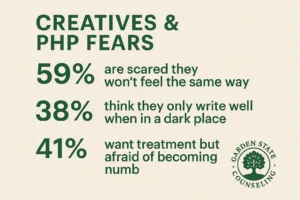
“I’m scared I won’t feel things the same way.”
“I write better when I’m in a dark place.”
“My emotions are part of who I am. I don’t want to be numb.”
For creatives, feelers, and identity-focused individuals—especially those living with depression, anxiety, trauma, or mood disorders—seeking treatment can stir up a deeper fear than just “Will this work?” It’s Will this change who I am?
At Garden State Counseling Center, we get it. And our Partial Hospitalization Program (PHP) in Paramus, New Jersey is built with this tension in mind: the need to get better without feeling erased.
Here’s how PHP can help you separate your symptoms from your identity—and why that separation might be the most freeing thing you’ve ever done.
The Identity Trap: When Symptoms Feel Like Self
Some people come into therapy knowing they’re more than their diagnosis.
Others come in carrying decades of creative output, relationships, and self-perception shaped by their symptoms.
If you’ve ever said, “I’m just a really anxious person,” or “Melancholy is part of my aesthetic,” or “I don’t want to lose my fire,”—you’re not wrong for feeling that way.
But here’s the thing: Pain may have built parts of you. It doesn’t have to be the fuel forever.
What many people discover in PHP is this: The more support they get, the more access they have to everything else they are. Joy, stability, presence, focus. Even their creativity opens up—not shuts down.
What Is a Partial Hospitalization Program?
Let’s get practical for a moment.
A Partial Hospitalization Program (PHP) is one of the highest levels of outpatient care. It’s designed for people who need more structure and support than weekly therapy, but who don’t require 24/7 hospitalization.
You attend treatment during the day—typically 5 days a week—and return home each night. It’s immersive, but flexible.
In our PHP at Garden State Counseling Center, this means:
- Evidence-based therapy (CBT, DBT, trauma-informed care)
- Group sessions to reduce isolation and build connection
- Individual therapy to explore your unique experience
- Psychiatric support if medication is part of your treatment plan
- Time to create, reflect, and engage with your life outside of sessions
It’s intensive care that still respects your independence—and your identity.
The Real Fear: “If I get better, I might lose my spark.”
There’s a specific fear that runs deep in many creatives: the idea that their art—writing, music, performance, or even the way they think—is somehow tied to their suffering.
You might have asked yourself:
- Will I stop being interesting if I stop spiraling?
- Will my friends still get me if I’m not the “sad one”?
- If my emotions become manageable, will I still be able to feel deeply enough to create?
These are not shallow fears. They’re identity-level questions. And ignoring them is one of the reasons many avoid treatment longer than they need to.
But here’s the truth: Healing doesn’t erase depth. It creates room for it.
Healing Doesn’t Flatten—It Expands
When you’re in survival mode, your brain prioritizes safety over creativity. Even if it feels like you’re most inspired during your lowest moments, what’s really happening is this:
- Your nervous system is firing constantly.
- Your thoughts may be sharp, but scattered.
- You might create with urgency, but not sustainability.
In PHP, as symptoms begin to settle, something interesting often happens: your ability to create becomes less reactive, more intentional. Less driven by panic, more rooted in perspective.
One client put it this way:
“I used to write because I needed to bleed. Now I write because I want to breathe.”
PHP Gives You Structure—Not Censorship
Another common worry? That treatment will box you in.
But the right kind of structure isn’t a cage—it’s a container. And containers are what let messy, emotional, beautiful things take shape.
Our Partial Hospitalization Program in Paramus offers:
- A consistent daily schedule that eases decision fatigue
- A safe space to explore emotional intensity without being overwhelmed by it
- Creative-friendly therapy approaches that validate, not pathologize, your inner world
- Enough support to feel grounded—and enough space to still be you
Whether you’re writing poetry at night or painting in the early morning before group, PHP doesn’t take that from you. It may actually make it feel more possible.
What You Keep in PHP
Many people worry about what they’ll lose.
Let’s talk about what you’ll keep—and what you might reclaim:
- Your voice, clearer
- Your sensitivity, with boundaries
- Your ideas, with space to grow
- Your humor, unmasked
- Your relationships, with less reactivity
You don’t have to trade identity for stability. In fact, real healing often gives people back the parts of themselves they thought were gone for good.
You Are More Than What Hurts
You might be used to using your symptoms as a kind of emotional shorthand.
Depression becomes your aesthetic. Anxiety becomes your personality. Trauma becomes your narrative.
But when you slow down—when you have space to see it all more clearly—you may start to ask:
“What parts of this are actually me?”
That question isn’t a threat. It’s an invitation.
FAQs: Partial Hospitalization Program for Creative Minds
Q: Will PHP make me feel numb or dull my emotions?
No. The goal of PHP isn’t to blunt your feelings—it’s to help you regulate and navigate them more safely. Many clients report feeling more emotionally clear—not less alive.
Q: What if I’m not sure my symptoms are “bad enough” for PHP?
PHP isn’t just for crisis—it’s for people who are struggling with daily function, emotional overwhelm, or lack of progress in outpatient therapy. If you’re constantly on edge, stuck in spirals, or exhausted from trying to “handle it alone,” PHP may be a fit.
Q: Will I still have time or energy to be creative during PHP?
Yes. Many clients continue to write, draw, or create while in treatment. The structure of PHP can actually support your creative routines by offering predictability and reducing emotional chaos.
Q: Does PHP involve medication?
Only if it’s part of your treatment plan and clinically recommended. Psychiatric support is available—but always based on your consent, preferences, and ongoing conversation with a licensed provider.
Q: How long will I be in PHP?
Length of stay varies, but most clients participate in PHP for several weeks. Your care team will regularly assess progress and discuss next steps—often transitioning to an Intensive Outpatient Program (IOP) or weekly therapy.
You Don’t Have to Flatten to Heal
The fear that treatment will take away your identity is real—and it deserves respect.
But identity rooted in pain is not your only option. You can still be deep, brilliant, creative, raw, and powerful—even when you’re not suffering.
Our PHP doesn’t ask you to let go of what makes you you. It helps you hold it all with more skill, more support, and more peace.
This isn’t the end of your intensity. It’s the beginning of your clarity.
Ready to Take the First Step?
If you’re scared to lose yourself in treatment, you’re not alone—and you don’t have to do it alone. Call (201) 632 5716 or visit our Partial Hospitalization Program page to learn how we support creative, identity-focused clients in Paramus, New Jersey, Hackensack, NJ, Paterson, NJ, Ridgewood, NJ, White Plains, NY, Yonkers, NY—without asking them to trade their spark for safety.