


The first time I called, I was scared. The second time, I was ashamed.
Ninety-three days after leaving treatment, I relapsed. I didn’t plan to. I wasn’t “testing” myself. I just got tired. The coping skills started to feel flimsy. Life started piling up. One minute I was just managing stress, and the next—I was back where I swore I’d never be.
I kept telling myself I could pull it together. I thought, I’ve been through residential treatment before. I know what to do. But knowing isn’t the same as doing. And by the time I admitted I needed help again, shame had taken over.
What finally broke through wasn’t some brave epiphany. It was exhaustion. I couldn’t keep pretending I was fine. So, one night, I picked up my phone and made the hardest call I’ve ever made: I called the team at the residential treatment program that once helped me find solid ground.
What I heard on the other end of the line wasn’t judgment. It wasn’t disappointment. It was this:
“I’m so glad you called.”
Relapse Doesn’t Erase the Work You’ve Already Done
That was the first thing I had to re-learn.
Relapse has a nasty way of rewriting your narrative. It whispers things like:
- You’re back at square one.
- None of it mattered.
- You wasted everyone’s time—especially your own.
But those voices lie. They’re shame in disguise. And the truth is, the work you did in treatment still lives in you. It’s not gone—it’s just been buried under panic, guilt, and fatigue.
When I walked back into Garden State Counseling Center’s Residential Treatment Program in Ridgewood, NJ, they didn’t treat me like a failure. They treated me like someone brave enough to return. And that changed everything.
I Wasn’t Afraid of Judgment. I Was Afraid of Disappointment.
It took me days to make that call—not because I was afraid of being scolded, but because I was afraid they’d be disappointed in me.
I didn’t want to hear, “Really? You again?”
I had been the success story. The one who left treatment stable, smiling, with a plan. I imagined their faces falling when they saw my name pop up again. I thought, They’ll be done with me.
But that never happened. The moment I called, they didn’t focus on my mistake. They focused on what I needed next.
And instead of closing a door, they opened one I forgot was still mine.
Returning Didn’t Feel Like Starting Over
Walking back into treatment after relapse felt vulnerable—but not unfamiliar. I didn’t need a full tour. I knew where the quiet spots were. I knew what group therapy looked like. I even remembered some of the staff.
But more than anything, I knew what questions I needed to ask this time. Questions like:
- What am I actually afraid of?
- What parts of myself did I ignore the first time?
- Where did I stop telling the truth?
This time, I didn’t walk in hoping to “graduate.” I walked in ready to get real.
And that made all the difference.
The Second Time, I Didn’t Hide What Still Hurt
The first time I went through treatment, I held back. Not on purpose. I just didn’t know what was safe to say.
I wanted to be the “good client.” The one who got better fast. The one who didn’t take up too much space.
But behind that pressure was fear—and that fear never really left. So even though I completed the program, some of the deeper stuff? I never said it out loud.
The second time, I didn’t have the energy to pretend. I cried early. I asked for help often. I let my therapist see the parts of me I was still scared of. And you know what? Nobody flinched.
They held it with me.
I Wasn’t the Only One Who Came Back
That shocked me.
I thought I’d be the only returner. But I wasn’t. Quietly, a few of us found each other. Some in group. Some in the hallway. Some during a late-night cup of tea.
“I came back too,” someone whispered one night, as we cleaned up after group.
And suddenly, I felt less like a failure—and more like part of something real. Recovery isn’t a straight line. And a relapse doesn’t void your membership in healing.
It just reminds you that this work is still ongoing. And still worth doing.
Here’s What Actually Happened When I Called Back
Let me tell you what calling my residential treatment program after a relapse actually looked like:
- I didn’t have to explain everything right away.
- They didn’t make me “justify” why I was calling.
- I wasn’t shamed, guilt-tripped, or dismissed.
- They asked me one question: “What do you need right now?”
And I didn’t even know the answer yet. That was okay. They helped me figure it out.
Within days, I had a care plan. An intake appointment. And a team that remembered me—not just my file, but me.
What I Know Now, Looking Back
Relapse isn’t a moral failure. It’s a signal.
For me, it meant something still needed attention. A wound I hadn’t touched. A truth I hadn’t told. A rhythm I hadn’t honored.
Going back to residential treatment didn’t make me weak—it made me wise enough to stop the spiral before it got worse.
And it gave me something I didn’t realize I’d been missing: permission to keep healing.
Because this isn’t about perfect recovery. It’s about honest recovery.
Frequently Asked Questions (from Someone Who Relapsed)
Will I be judged for coming back to residential treatment?
No. At Garden State, I was met with compassion, not criticism. The team understands that relapse is part of the process for many people. It’s not a failure—it’s a chance to go deeper.
Will I have to explain everything to be accepted again?
Not at all. I shared what I could when I was ready. The staff didn’t demand a play-by-play. They cared more about what I needed now than what went wrong then.
Will my progress from last time still count?
Yes. I didn’t start from zero. The work I did before helped me recognize patterns, ask better questions, and re-engage faster. I picked up where I left off—with more honesty.
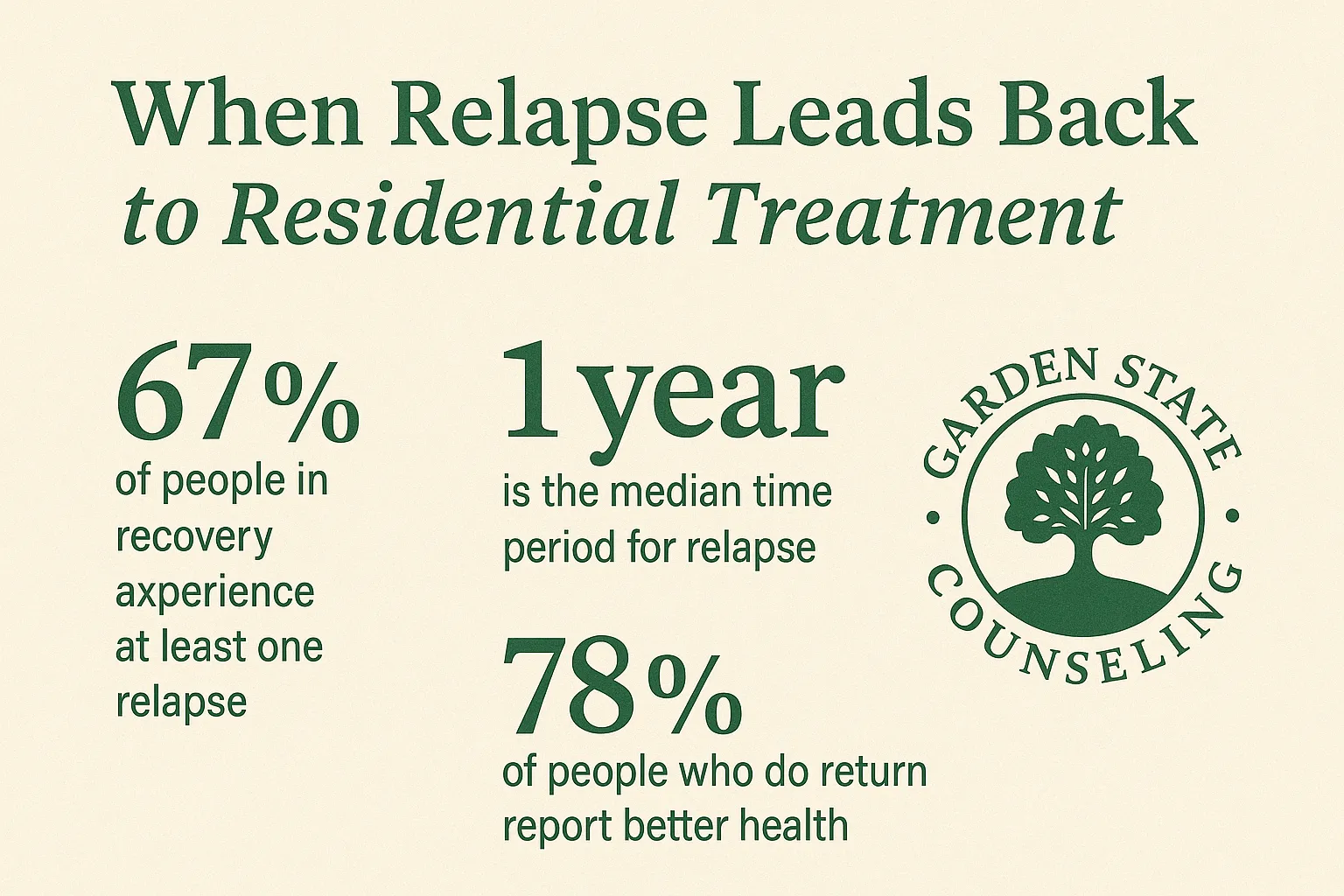
Is relapse common after residential treatment?
Yes. More common than most people admit. The shame makes it hard to talk about, but it happens—and programs like Garden State know how to support people through it without stigma.
What if I don’t know if I need full residential again?
That’s okay. When I called, they helped me explore my options—whether it was another round of residential, a step-down program, or intensive outpatient care. You don’t have to decide alone.
If You’re Sitting There Holding Your Phone—This Is for You
Maybe your last day in treatment was proud, hopeful, strong.
Maybe you never thought you’d be reading this blog. Maybe you’re ashamed to even be considering a return.
But listen: the door is still open.
You’re not broken because you slipped. You’re not disqualified because the old patterns came back. You’re not weak because you need more support.
You’re human.
And if you need someone to walk with you—again—Garden State Counseling Center’s Residential Treatment Program is still here. Still steady. Still safe.
All you have to do is call.
Call (201) 632-5716 or visit our Residential Treatment Program in Paramus, New Jersey to talk to someone who gets it. No shame. No pressure. Just real support—whenever you’re ready to return.