



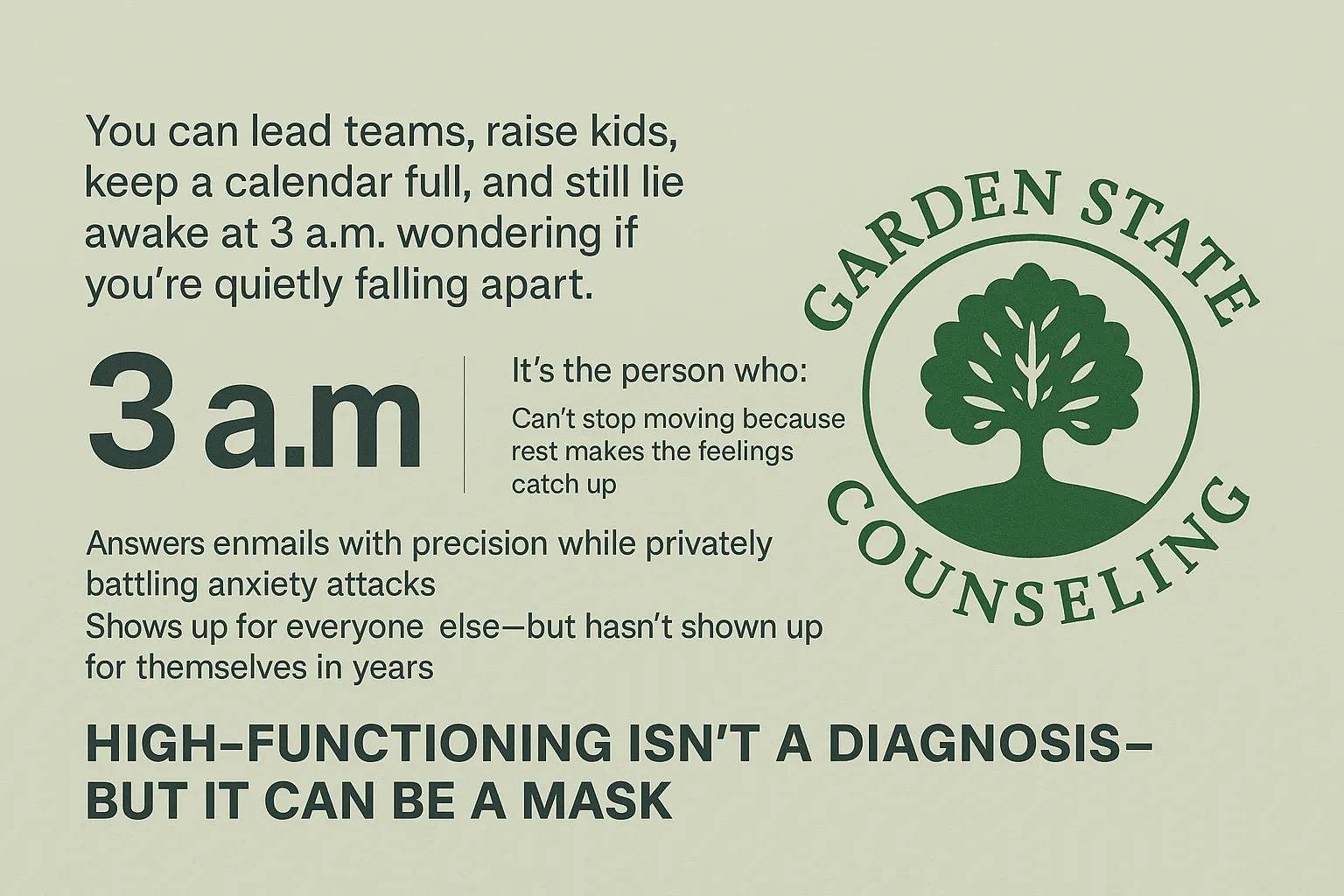
You can lead teams, raise kids, keep a calendar full, and still lie awake at 3 a.m. wondering if you’re quietly falling apart.
From the outside, it looks like you have it together. You hit deadlines. You remember birthdays. You give good advice. But inside, there’s a kind of tiredness that no amount of sleep can fix. There’s a numbness you don’t talk about. There’s a feeling that you’re not living so much as performing—and you’re running out of energy to keep up the act.
At Garden State Counseling Center, we see this every week. Smart, capable, deeply exhausted people walking into our Partial Hospitalization Program in Paramus, New Jersey—not because they’ve failed, but because they’re done surviving silently.
High-Functioning Isn’t a Diagnosis—But It Can Be a Mask
There’s no official clinical label for “high-functioning,” but we all recognize it.
It’s the person who:
- Can’t stop moving because rest makes the feelings catch up
- Answers emails with precision while privately battling anxiety attacks
- Shows up for everyone else—but hasn’t shown up for themselves in years
High-functioning people often carry deep emotional pain alone because they think they should be okay. And because everyone else assumes they are.
So they keep going. Until the cost becomes too high.
Partial Hospitalization Programs Aren’t Just for Crises
Many of our clients are surprised to learn that a Partial Hospitalization Program (PHP) isn’t only for people in acute crisis. It’s also for those who are:
- Managing mental health symptoms quietly but not sustainably
- “White-knuckling” their way through each day
- Too stable for inpatient care but too overwhelmed for weekly therapy
PHP provides structure, clinical support, and daily therapeutic work—without requiring you to step away from life entirely.
It’s a bridge between barely coping and truly healing.
Why High-Functioning Adults Often Wait Too Long
We’ve seen it happen over and over again: people waiting until their marriage, job, or health is in danger before reaching out. Why?
Because high-functioning adults are good at rationalizing their struggle. They say things like:
- “It’s just a busy season.”
- “Other people have it worse.”
- “I should be able to handle this.”
But there’s a difference between being capable and being well. And by the time you’re Googling programs at midnight, something inside you already knows—this isn’t sustainable.
What Partial Hospitalization Looks Like (When You’re High-Functioning and Hurting)
Here’s what you can expect from our Partial Hospitalization Program in Yonkers, NJ:
Daily Schedule
- Five days per week
- Typically from morning through early afternoon
- Includes breaks, quiet spaces, and built-in decompression time
Core Services
- Individual therapy to unpack long-standing patterns and burnout
- Group therapy that feels human—not like a forced circle of strangers
- Psychiatric support, if medication is being explored or managed
- Skills training in boundaries, emotional regulation, and identity work
You’ll go home each evening—which means you don’t disappear from your life. You reconnect to it, piece by piece.
This Isn’t About “Fixing” You
One of the hardest things for high-functioning clients is giving themselves permission to need help without catastrophizing it.
You don’t have to call it a breakdown.
You don’t need to be in a full-blown crisis to deserve care.
Our role isn’t to fix you. It’s to walk with you as you:
- Make sense of what you’ve buried under achievement
- Feel safely, without fear of unraveling
- Redefine success in a way that includes rest, honesty, and mental peace
What We See as Clinicians (That You Might Not Say Out Loud)
We’ve learned to listen beneath the surface.
You might come in saying:
- “I’m just burned out.”
- “I don’t even know why I’m here. I’m not like other people.”
- “I should be able to handle this.”
But we see the telltale signs:
- Your voice shakes when you talk about your childhood
- You can’t name what you need because you’ve never been allowed to
- You apologize for taking up space, even in therapy
We help you learn that needing care isn’t a failure of strength—it’s a form of courage.
The Shift: When Functioning Becomes Living
High-functioning people often confuse functioning with thriving. They’re not the same.
Functioning is showing up.
Thriving is showing up as yourself—without fear, without a mask.
That shift doesn’t happen all at once. But in PHP, we’ve watched it unfold:
- A client who never cried finally does—and doesn’t apologize
- Someone who always led group starts listening instead of fixing
- A high-achiever lets go of perfection and accepts being
You don’t lose your edge in healing. You lose your armor. And you find your way back to something more honest.
You Can Still Keep Moving—But You Don’t Have to Keep Running
Many clients worry that entering a program means pressing pause on everything. But PHP isn’t about pausing your life—it’s about re-entering it differently.
You’ll still have evenings at home.
You can still be present for your family.
You can still handle responsibilities—just not alone, and not at the cost of your sanity.
You don’t have to quit being functional. But we do help you stop using “functional” as a shield against your own pain.
What Comes Next?
After PHP, clients often move into:
- Intensive outpatient programs (IOP)
- Weekly therapy
- Coaching or community support
- Medication management or specialty referrals
We help create a transition plan that honors your progress and supports long-term balance—not just symptom relief.
Frequently Asked Questions
Do I really need PHP if I’m still functioning “fine”?
Yes. Functioning doesn’t mean thriving. If your inner life is suffering, PHP can help you address what’s going on beneath the surface—even if everything looks okay on the outside.
Will I be surrounded by people in more acute crisis than me?
Our PHP often includes a mix of clients, many of whom are professionals, caregivers, or high-achieving individuals. You won’t be out of place—and your struggle is just as valid.
How much of my day will PHP take?
Our program typically runs five days a week, for several hours a day. You’ll return home in the afternoons. We can discuss scheduling needs and how to integrate this into your life.
Is PHP confidential? I don’t want people at work or home to know.
Absolutely. We uphold strict confidentiality standards. We’ll also work with you on how to communicate (or not communicate) your treatment journey based on your comfort level.
What if I’ve never done therapy before?
That’s okay. Many clients begin their healing journey here. You don’t need prior experience—just willingness to be honest and open, even if that feels awkward at first.
You’re Allowed to Stop Pretending
High-functioning doesn’t mean happy. It doesn’t mean regulated. It doesn’t mean okay.
It means you’ve learned to cope well enough to avoid attention. And now, something in you is asking: Isn’t there more than this?
Yes. There is.
You don’t have to break to get help. You just have to stop hiding your hurt.
Call (201) 632-5716 or visit our Partial Hospitalization Program in Paramus, New Jersey to learn how we support high-functioning adults who are ready to stop pretending and start living—for real.