


You love your child. That’s never been the issue. The issue is—no matter how hard you try, you can’t seem to reach them anymore.
They’re using again. After all the progress, all the therapy, all the promises… it’s happening again. And every time they lie, withdraw, or disappear, it feels like they’re choosing drugs over the people who’ve never stopped loving them.
If that sentence punched you in the gut, you’re not alone.
At Garden State Counseling Center, we offer EMDR therapy in Paramus, NJ to help young adults untangle the deep emotional pain that often fuels substance use. And we support parents like you—exhausted, scared, and still trying to hold on.
Let’s talk about what might be happening under the surface—and how EMDR can help.
Your Child Isn’t Choosing Substances Over You. They’re Choosing Survival.
It doesn’t feel like survival. It feels like betrayal. But here’s what many clinicians know from years of experience: people in active addiction aren’t thinking in terms of love or logic. They’re responding to pain. Shame. Fear. Panic.
That hit, that pill, that binge—it’s not about the high. It’s about escape. About making the chaos inside go quiet for even a moment.
In that state, nothing else exists. Not family. Not future. Not the promises they made. Just relief.
This isn’t about excusing the damage. It’s about understanding the engine beneath it. Because when parents can see that engine clearly, they stop blaming themselves—and they start choosing responses that heal, not harm.
EMDR Helps Treat the Shame That Fuels Addiction
EMDR stands for Eye Movement Desensitization and Reprocessing. While it’s best known as a trauma treatment, it’s also a powerful tool for addressing the emotional and physiological root causes of substance use.
Why does this matter?
Because shame, unresolved trauma, and emotional dysregulation are three of the most common reasons people use. EMDR helps process these issues without requiring your child to talk about everything out loud—or to have all the answers.
Here’s what happens in an EMDR session:
- A licensed therapist helps your child identify a memory, belief, or feeling that feels “stuck.”
- While your child thinks about this target, the therapist uses bilateral stimulation (like moving lights, tones, or taps).
- This back-and-forth motion helps the brain reprocess the memory more safely, reducing its emotional charge.
- Over time, the body and mind stop reacting like the trauma is still happening.
Many clients describe it as finally being able to breathe again—like the “emotional static” gets quieter.
Why Your Child Might Be Pushing You Away
You show up. You love hard. You don’t give up.
And still—your child keeps pulling away.
This is often one of the most painful parts for parents. But beneath that emotional distance is often something less cruel and more tragic:
- They believe they’ve failed you and don’t know how to face it.
- They fear your disappointment more than they fear withdrawal.
- They think if they stay away, you’ll hurt less.
- They feel unworthy of closeness, so they destroy it preemptively.
- They equate connection with pressure—and pressure feels like drowning.
EMDR can’t “fix” relationships overnight. But it can help your child untangle these beliefs. As shame starts to loosen its grip, they often feel safer reconnecting with people who care.
EMDR Isn’t Just for “Big T” Trauma—It’s for Emotional Survival Patterns
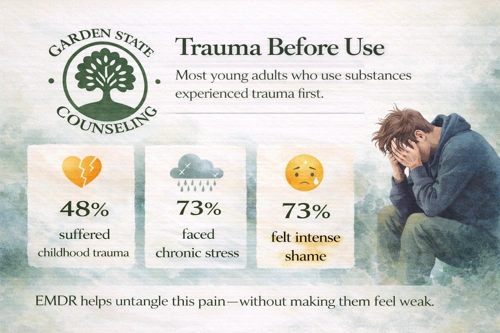
A lot of young adults who use substances don’t think they’ve experienced “real trauma.”
But trauma isn’t only abuse or assault. It’s:
- Feeling invisible in your own home
- Being bullied, rejected, or shamed at a formative age
- Internalizing beliefs like “I’m not enough” or “I ruin everything”
- Growing up with a parent who was emotionally unpredictable
- Never feeling truly safe, seen, or soothed
These experiences get wired into the nervous system. And when the body doesn’t feel safe inside, substances often feel like the only escape.
EMDR helps the body learn that the danger has passed. It gives young people the tools to feel emotions—without being overwhelmed by them.
You Can’t Force Recovery. But You Can Offer a Path.
By the time parents reach out to us, they’ve usually tried everything:
- Tough love
- Second chances
- Ultimatums
- Quiet suffering
- Fix-it mode
- Complete shutdown
If this is you: we see you. You’ve done more than most people know.
Here’s what you can do next:
- Learn what trauma-based therapy like EMDR offers
- Gently share it as an option—not a demand
- Set boundaries that protect you and express love
- Stop taking their behavior as proof that you’ve failed
- Consider your own support, healing, or therapy
If your child isn’t ready to walk through the door, you can still light the way.
What Happens If They Start EMDR Therapy?
When a young adult begins EMDR with us, we never throw them into deep trauma work right away.
We start with:
- Stabilization and safety
- Understanding how their body responds to stress
- Teaching grounding techniques
- Building trust in the therapeutic relationship
Once they’re ready, we move into reprocessing—slowly and with their consent.
Over time, EMDR can lead to:
- Fewer emotional blowouts
- Less impulsive, destructive behavior
- Increased self-awareness and insight
- The ability to feel without needing to numb
- More willingness to reconnect—with you, and with themselves
And no, it’s not always linear. There are setbacks. But the shifts are real.
Looking for EMDR in Hackensack or White Plains?
Many families come to us after searching for EMDR in Hackensack or Paterson. Even if you’re outside of Paramus, our clinicians regularly serve clients across Bergen County and beyond.
Sometimes a little distance from home makes the space feel safer to open up.
FAQ: EMDR for Parents of Kids in Active Use
Can EMDR work if my child is still using?
It depends. If they’re actively under the influence during sessions, EMDR won’t be effective. But if they’re sober enough to engage—even for short periods—it can still help.
Do they have to talk about their trauma for EMDR to work?
No. EMDR doesn’t require full disclosure. It works through the brain and body, not just verbal processing. Clients only share what they feel safe sharing.
Is EMDR part of a full addiction treatment program?
It can be. EMDR is most effective when used alongside addiction support like outpatient care, group therapy, or medication management, depending on the situation.
What if they try it and quit?
It happens. Many clients need more than one attempt to stick with therapy. We keep the door open. And just starting EMDR—even briefly—can plant seeds for future growth.
Can EMDR help me as a parent?
Absolutely. If you’re carrying your own trauma, grief, or parenting guilt, EMDR can help you process that too. You deserve support, not just them.
If They Won’t Come Through the Door Yet—You Still Can
Sometimes, the only thing you can do is refuse to give up on hope.
Not blind optimism. Not fantasy. But grounded hope—the kind that says:
“My child is still in there. And healing is still possible.”
At Garden State Counseling Center, we don’t offer easy answers. But we do offer trauma-informed, shame-free therapy that helps young people find their way back to themselves—and their families.
Call (201) 632 5716 to learn more about EMDR therapy in Paramus, New Jersey.
We’ll be here—when they’re ready, and while you wait.