


When a doctor says the words—bipolar disorder, depression, anxiety, borderline personality disorder—it’s not always a moment of relief. For many people, it lands like a punch to the chest. You finally have a name for what you’re feeling, but now what? Does this mean you’re broken? Does it mean you’ll have to take medication forever? Who are you going to be on the other side of this?
If you’re newly diagnosed and scared to take medication, we want you to know something right away: you’re not alone—and you don’t have to figure it all out at once. Dialectical Behavior Therapy (DBT) is a proven approach that can help you feel more grounded and less overwhelmed while you decide what kind of treatment feels right for you.
At Garden State Counseling Center, we offer Dialectical Behavior Therapy in Paramus, New Jersey, designed specifically for people navigating these early, uncertain stages. You don’t need to be ready for everything. You just need to be willing to start where you are.
You Don’t Have to Be “Sure” Yet—DBT Holds Space for Uncertainty
When you’re newly diagnosed, everyone around you may seem to want answers. Are you starting meds? Are you seeing a psychiatrist? Are you going to be okay?
But here’s the truth: you’re allowed to take your time.
DBT doesn’t ask for immediate buy-in or long-term certainty. It meets you in the in-between space. You don’t have to agree with your diagnosis. You don’t even have to want help. All you need is curiosity—and a willingness to learn a few new ways to handle the hard moments.
In that way, DBT can become a soft landing instead of another overwhelming decision.
What Is DBT, Really?
DBT stands for Dialectical Behavior Therapy. It’s a structured, skills-based therapy created to help people manage intense emotions, impulsive behaviors, and unstable relationships—but it’s also deeply useful for anyone dealing with emotional dysregulation.
There are four core skill sets in DBT:
- Mindfulness – learning to notice your thoughts and feelings without judgment
- Distress Tolerance – surviving painful moments without making things worse
- Emotional Regulation – understanding, naming, and managing emotions
- Interpersonal Effectiveness – setting boundaries and asking for what you need
Each of these can be life-changing on its own. Together, they create a kind of emotional toolbelt that helps you move through life with more agency—even if nothing around you changes.
You’re Not Broken. You’re a Human Being Who Feels Deeply.
If you’ve ever been told you’re “too much,” or if your emotions come on like waves you can’t control, DBT is here to say: you make sense. Emotions aren’t bad. They’re messengers. The goal of DBT isn’t to flatten you out—it’s to help you listen, interpret, and respond in ways that don’t hurt you or the people you care about.
It’s not about becoming “less emotional.” It’s about gaining the skills to feel what you feel without being consumed by it.
As one of our clients put it:
“DBT didn’t fix me. It taught me how to stay with myself—even on the days I didn’t want to.”
If You’re Not Ready for Medication, DBT Can Help You Stabilize First
We work with many people who are hesitant—or even afraid—to take psychiatric medication. You might worry it will numb your creativity, dull your personality, or change you in some unrecognizable way.
We hear you.
Choosing whether or not to take medication is deeply personal. And while we always encourage clients to work with a trusted prescriber to explore their options, we also recognize that some people need time.
DBT gives you a way to start doing something right now—without forcing a decision about meds. You can still make progress. You can still feel better. You can still grow.
Sometimes, having those skills in place makes the decision about medication feel less scary, not more.
DBT Is Active—You Learn, You Practice, You Get Better
One of the most empowering things about DBT is how practical it is. It’s not about talking in circles or rehashing the past over and over. It’s about learning specific skills and applying them to your real life.
- What do you do when a wave of panic hits at 2am?
- How do you come down after an emotional spiral without self-harming or lashing out?
- How can you say no without guilt—or yes without fear?
DBT answers these questions. And more importantly, it gives you tools to answer them for yourself, over and over, as your life evolves.
Therapy Doesn’t Have to Rush You—We Don’t
Here’s what we promise:
At Garden State Counseling Center, we never push.
We don’t pressure you into decisions you’re not ready to make.
We understand what it feels like to be overwhelmed by the very idea of getting help.
You are allowed to go slow.
Our DBT program in Paramus is designed with that in mind. Whether you’re a young adult struggling to manage your emotions, a parent trying to stay afloat, or someone who’s just been handed a new label and doesn’t know what it means—we’re here for you.
What If You Don’t Know What You’re Feeling?
That’s common. Especially right after a diagnosis.
You might feel sadness one day and numbness the next. Rage that comes out of nowhere. Or a dull ache that follows you around like fog.
DBT helps you name those feelings. Not so you can “fix” them—but so they don’t control you from the shadows.
There’s relief in naming things. And power in knowing that emotions are waves, not definitions.
DBT Works Best When You Feel Like It Won’t
Many people are skeptical at first. That’s okay. You don’t have to believe in it yet. Just try it. Try showing up for a group. Try doing one skill sheet. Try the “STOP” skill next time you feel the urge to react without thinking.
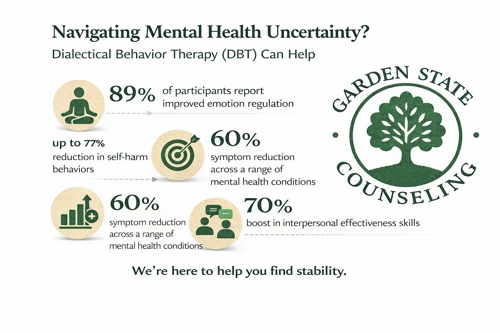
DBT isn’t magic. But it is evidence-based—and it’s helped thousands of people feel more stable, more whole, and more capable of facing whatever comes next.
You’re not an exception. You’re just early in the process.
FAQs About DBT for the Newly Diagnosed
Is DBT only for people with borderline personality disorder (BPD)?
No. While DBT was originally developed for BPD, it’s now widely used for many mental health conditions including anxiety, depression, bipolar disorder, PTSD, and emotional dysregulation in general.
Can I do DBT if I’m not taking medication?
Yes. DBT is a skills-based therapy that can be effective on its own. While some people use it alongside medication, others use it as a standalone support—especially when they’re still deciding about meds.
What if I’m not ready to talk in a group?
That’s okay. DBT can be done one-on-one or in a group setting. Many people start with individual DBT therapy and add groups later when they feel ready.
How long does DBT take to start working?
Most people begin noticing small shifts after a few weeks—especially if they practice skills outside of sessions. That said, DBT is a long-term therapy, often structured as a 6–12 month program.
Do I have to commit to a year of therapy to try it?
Not at all. You’re always in control of your participation. Some people explore DBT for a few sessions and decide from there. There’s no pressure to commit beyond what feels right to you.
You’re Still You—This Just Helps You Feel More Like Yourself
A diagnosis doesn’t define you. Fear doesn’t disqualify you. Not knowing what you want yet doesn’t mean you’re lost forever.
You can take your time.
You can keep your spark.
And you can still get support.
If you’re in or near Paramus and want to explore whether DBT might help, we’re ready when you are.
To learn more about our DBT therapy services in Paramus, New Jersey, click here.
Ready to take one small step?
Call (201) 632 5716 to learn more about our Dialectical Behavior Therapy in Paramus, New Jersey, Hackensack, NJ, Paterson, NJ, Ridgewood, NJ, We’ll meet you gently—exactly where you are.