



When your child is in emotional crisis, it doesn’t feel like a “rough patch.” It feels like panic, heartbreak, and helplessness all at once.
You may be watching your young adult spiral in and out of emotional storms—rage, shutdowns, self-isolation, panic attacks, risky behavior—and you’re unsure what will actually help. Everything you’ve tried feels like too little, too late. You’re exhausted. And still, you’re showing up.
That’s where Cognitive Behavioral Therapy, or CBT, often begins. Not as a full solution, but as a stabilizing step—a starting place when everything else feels like too much.
At Garden State Counseling Center, we offer CBT therapy in Paramus, New Jersey for families in crisis. Whether your child has a diagnosis or not, CBT is often one of the first tools we use to help young people get back on solid ground—emotionally, mentally, and behaviorally.
Why CBT Is Often the First Step After a Behavioral Crisis
In moments of behavioral or emotional crisis—especially in adolescents and young adults—the number one priority becomes stabilization. Before we explore why a breakdown happened, we need to help your child stop spiraling.
CBT helps do just that.
It doesn’t require deep emotional processing. It doesn’t rely on motivation. It doesn’t depend on “readiness” to change. Instead, CBT offers structure—calm, repeatable practices that can be used even when emotions are high.
CBT can:
- Interrupt destructive thought loops
- Identify triggers before they explode
- Offer small behavioral shifts that help regulate mood
- Build insight over time—without overwhelming your child
This is why CBT is often used first in therapy. It creates just enough calm to start thinking clearly again.
It Works Even Without a Diagnosis or Clear “Problem”
You may not have answers right now. Many parents don’t.
Maybe your child hasn’t been officially diagnosed. Maybe they won’t talk to a psychiatrist. Maybe you’re still waiting on evaluations or struggling to get them to agree to any kind of treatment.
That’s okay.
CBT doesn’t require labels. It’s one of the few therapeutic approaches that can meet someone right where they are—diagnosis or not, diagnosis in progress, or still refusing help entirely.
In fact, CBT often serves as a “foot in the door” for young adults who don’t believe they need therapy. Because it doesn’t ask them to talk about their childhood. It just asks them to look at how they think, what those thoughts make them feel, and how those feelings lead to actions.
And that’s something even reluctant clients can usually explore.
It Gives Them Tools for the Moments They Feel Least in Control
The most frightening part of an emotional or behavioral crisis is the lack of control—your child’s and your own. They don’t know why they’re acting the way they are. You don’t know what to do to help. Everything feels unpredictable.
CBT provides structure in the chaos.
It gives young people:
- Nameable patterns: They start to recognize when they’re falling into catastrophizing, all-or-nothing thinking, or self-judgment spirals.
- Grounding tools: CBT therapists teach methods to stop a thought spiral before it becomes a behavioral outburst.
- Replacement behaviors: Instead of self-harm or isolation, they learn options that reduce emotional intensity without causing damage.
- Practical language: They gain new words to explain what’s happening inside them—even if it’s just “I’m stuck in a loop right now.”
This is especially helpful for teens and young adults who feel ashamed of their reactions or afraid of their own minds. CBT doesn’t shame them—it empowers them.
CBT Helps Before You Know the “Why”
Parents often ask us: “But shouldn’t we figure out what’s really going on?”
Yes. But first, your child needs to be emotionally steady enough to participate in that deeper work.
If your child is suicidal, dissociating, engaging in risky behavior, or refusing to communicate, exploring “why” will backfire. They need to feel grounded before they can self-reflect.
CBT helps establish that baseline of emotional regulation.
Once their symptoms become more manageable, you can introduce additional treatment layers—like Dialectical Behavior Therapy (DBT), trauma-focused care, family therapy, or psychiatric consultation.
CBT is the pause button. The first breath. The ground beneath their feet so they can take the next step.
It’s Not About “Fixing”—It’s About Stabilizing
One of the biggest fears we hear from parents is: “Is my child broken?”
The answer is no.
Even in crisis, even in chaos—your child is not broken. They are overwhelmed. And their behaviors are often just loud signals that something inside is too big to manage alone.
CBT doesn’t treat your child like a diagnosis. It treats them like a human who’s caught in painful loops—and wants a way out, even if they don’t know how to say it.
You’re not asking them to become a different person. You’re helping them build a calmer, more manageable internal world—so they can be themselves again.
What You Might Notice as CBT Takes Hold
CBT progress doesn’t always look dramatic. Sometimes it’s incredibly quiet.
But here’s what parents often notice:
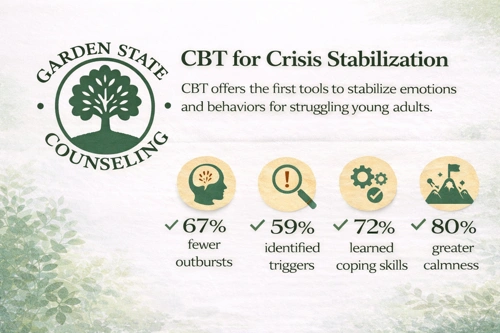
- Fewer emotional outbursts or shutdowns
- More awareness from their child (“I think I was catastrophizing earlier”)
- Less resistance to therapy or school
- New language for talking about stress, shame, or anxiety
- More moments of connection—not perfect, but more present
Over time, these small changes compound. They lay the groundwork for deeper healing, more honest conversations, and new emotional habits that stick.
FAQs: For Parents in the Middle of a Crisis
Will CBT work if my child doesn’t want therapy?
Sometimes yes, sometimes no. But CBT’s structured, skills-based approach is often easier for reluctant teens or young adults to engage with. It feels less invasive and more practical.
How quickly does CBT work in crisis situations?
Some young people feel relief in just a few sessions. But sustainable progress takes time—especially when emotions have been unstable for a while.
What if we’re still waiting on a psychiatrist or diagnosis?
You don’t have to wait. CBT can start before evaluations are complete. It’s often used as a first-line response in emotional or behavioral crises.
Is CBT enough on its own?
Sometimes, yes. Sometimes, it’s the beginning of a longer care journey. Our team can help assess whether more intensive treatment is needed and refer you if appropriate.
Will I be involved in the therapy process?
Possibly. For younger clients, we often involve parents in the early stages. For older adolescents or young adults, we take a collaborative approach that respects both autonomy and safety.
Call (201) 632 5716 to learn more about our Cognitive Behavioral Therapy in Paramus, New Jersey, White Plains, NY, Yonkers, NY, You don’t need all the answers yet. Just one steady step toward calm—for your child, and for you.