


I thought I was living the story of recovery I was supposed to live.
I stayed sober. I showed up to meetings. I worked. I volunteered. I helped others. I did every “right” thing I was taught to do. And yet… something felt empty, flat, incomplete.
There was no crisis. No relapse. Just a quiet, gnawing feeling that I had stopped growing. That the fire that once saved my life had cooled into a dull heat I pretended didn’t bother me.
I didn’t know what I needed—not really. I just knew that on the inside, I felt disconnected. Like I was coasting, not living. Like my recovery had become routine instead of alive.
That’s when I went back into therapy—not because I was collapsing, but because I finally admitted to myself that I wasn’t truly thriving anymore.
And what helped me most? Cognitive Behavioral Therapy, or CBT.
At Garden State Counseling Center, CBT gave me something my early recovery never did: clarity about my own mind, my unspoken beliefs, and the hidden patterns that kept me stuck even when I was doing “everything right.”
This isn’t a success story polished with cheer. It’s an honest account of what happened when a long‑term recovery journey met real introspection, curiosity, and the guts to slow down.
When “Doing Recovery” Becomes a Pattern, Not a Practice
For a long time, I equated activity with progress. If I’m busy with meetings, service work, exercise, reading books, volunteering, helping others—I must be healing, right?
CBT helped me see that doing a lot doesn’t always mean feeling better.
I was doing all the outward signs of recovery. But inside, I was numbing. Emotionally flatlining. Avoiding the real questions:
- What am I afraid of feeling if I slow down?
- What lies beneath my perfectionism?
- Am I helping others to avoid my own pain?
In CBT, you don’t talk around yourself. You look at your patterns. You name them. You watch how they show up in your thoughts, your emotions, your behavior. And then you start to ask: Are these patterns helping me? Or keeping me stuck?
That’s not soft therapy talk. That’s gritty introspection. And for someone who always had answers—especially polished ones—it was terrifying.
CBT Doesn’t Blame the Past — It Helps You Understand the Present
One of my biggest fears when I went back into therapy was that I’d be asked to relive my worst moments again. To unpack trauma I’d already talked about. To dredge up memories that I thought I’d already “done the work on.”
But CBT didn’t start there.
It started with right now.
It asked:
- What do you think when you wake up?
- What do you say to yourself when you make a small mistake?
- What patterns repeat when you’re stressed?
CBT doesn’t deny the past. It just doesn’t let the past run the show today.
That distinction alone was powerful for me.
Because I’d spent years trying to fix my history—when what I really needed was to understand how my history was living in me now.
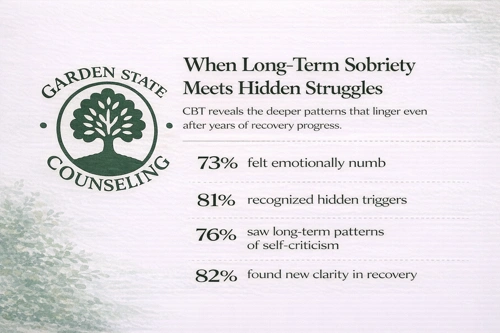
CBT revealed that overachieving, self‑criticism, and numbing weren’t signs of strength. They were survival strategies that had stopped serving me long ago.
I Had to Slow Down Before I Could See Myself Clearly
Here’s one thing no one tells you: if you’ve spent years performing recovery—you can avoid your own interior life without even noticing.
You can stay sober, keep busy, check all the boxes—and still keep your thoughts, your fears, and your emotional pain relegated to the shadows.
CBT forced me to slow down. Not physically, necessarily—not at first—but cognitively. Emotionally. Mentally.
I started noticing:
- Thoughts that never served me
- Old beliefs I still believed
- Ways I still numbed when the feelings got too close
And slowing down didn’t feel safe at first. It felt like walking into a storm you’d learned to outrun.
But that storm was not destruction. It was clarity.
Naming the Thoughts That Ran the Show
CBT introduces you to something deceptively simple: your thoughts are not facts.
That doesn’t sound revolutionary until you realize how much of your life you’ve believed thoughts that aren’t true, helpful, or grounded in reality.
For me, CBT helped me identify thoughts like:
- If I don’t look strong, I’ll lose respect.
- If I’m not helping everyone else, I don’t matter.
- I’m not allowed to be tired, frustrated, or sad.
Those thoughts weren’t my reality. They were echoes of old fears living in a calmer life.
Once I started noticing them—
once I wrote them down, challenged them, reframed them—
everything shifted.
Not suddenly. Not with grand revelation. But steadily, like water wearing away rock.
CBT Taught Me to Catch My Thought Patterns in Real Time
One of the most practical parts of CBT is learning to catch thought patterns as they happen.
You learn to notice:
- Negative self‑talk
- Automatic judgments
- Assumptions you never questioned
And then you learn to ask:
- Is this thought true?
- Is it useful?
- Is there another way to think about this?
I remember the first time I applied this to myself, mid‑spiral:
I thought, I’m a failure because I didn’t respond perfectly to that text.
CBT helped me slow down and ask:
- Was that thought true?
- Was it helpful?
- Could I see the situation another way?
The answer wasn’t “just be positive.” It was, I did the best I could in that moment, and one imperfect text doesn’t define my worth.
That kind of clarity didn’t come from just talking.
It came from thinking with intention.
When Recovery Starts to Feel Like Your Own
CBT didn’t make my pain disappear. It didn’t make me feel perfect. But it made me feel aligned.
For the first time, I wasn’t just doing recovery—I was engaging with it. I could:
- Notice old coping patterns without being controlled by them
- Respond instead of react
- Recognize when I was numbing instead of authentic
- Hold discomfort without panic
That’s where trust returned—trust in myself, not just the process.
I used to think recovery was about fixing everything.
Now I know it’s about understanding everything.
CBT didn’t erase my history—
it helped me stop letting my history run my present.
When Old Patterns Hide in Plain Sight
Even after years of stability, old patterns sneak back in. They hide in:
- Perfectionism dressed as competence
- Over‑giving disguised as service
- Numbing labeled as “self‑care”
- Avoidance wrapped in busyness
CBT taught me that sobriety isn’t the end. It’s the foundation.
What you build on that foundation matters.
I stopped confusing sobriety with peace. I stopped equating achievement with healing. I stopped pretending that discomfort meant I was failing.
I started watching my thoughts, recognizing my triggers, and responding to myself with compassion instead of criticism.
That was a turning point.
CBT Doesn’t Tell You What to Think—It Shows You How to Think
That’s what made all the difference.
I didn’t need someone to hand me answers. I needed someone to help me see the questions I was never asking.
Questions like:
- Why do I still fear quiet moments?
- Why do I numb discomfort even when I’m sober?
- What beliefs am I still holding that don’t serve me?
- What does safety actually feel like?
CBT helped me uncover the silent rules I lived by—and then decide if they deserved to stay.
Real Questions Alumni Often Ask
Do I need CBT even if I’ve been sober for years?
Yes. CBT isn’t just for crisis. It’s for clarity. It’s for anyone who wants to understand their thinking—not just their behavior.
Is CBT only for early recovery?
No. It’s useful at any stage. For many long‑term alumni, CBT helps move from surviving sobriety to living fully.
Is CBT about thinking positive?
Not at all. It’s about thinking accurately—recognizing distortions and learning to see situations more clearly and helpfully.
Can CBT help with emotional numbness or disconnection?
Yes. CBT helps you notice internal experience without judgment, so you can reconnect with emotions you’ve learned to avoid.
How long does CBT take?
Some people notice shifts quickly—within weeks. But meaningful change grows over months of consistent insight and practice.
Call (201) 632 5716 to learn more about our CBT services in Paramus, New Jersey, Hackensack, NJ, Paterson, NJ, Ridgewood, NJ. You don’t have to start over. You just have to start again—with awareness, intention, and tools that meet you where you are today.