



“I’m worried I won’t be myself anymore.”
People say this more often than you might think.
Sometimes it’s said with a nervous laugh. Sometimes it comes out after a long pause. Either way, the fear is real: the idea that asking for help might somehow erase the parts of you that make you you.
Before anything else, it helps to know this: the goal of care isn’t to change your identity. It’s to help you reconnect with the parts of yourself that depression may have slowly pushed out of reach. Many people start exploring support through services like depression therapy when they realize something inside them feels buried—not gone.
Fear of Losing Yourself Is More Common Than You Think
Creative people sometimes worry they’ll lose their depth.
Sensitive people worry their emotions will flatten.
Thoughtful people worry they’ll become less interesting or less complex.
Depression can make identity feel fragile. When you’re already struggling, the idea of changing anything—even for the better—can feel risky.
That hesitation doesn’t mean you’re resistant to help.
It often means you care deeply about who you are.
Depression Already Changes the Way Life Feels
One of the quiet truths about depression is that it already reshapes parts of daily life.
Energy fades.
Motivation disappears.
Things that once mattered start feeling distant.
Over time, people often start believing those changes are simply their personality now.
But many of those shifts are symptoms—not identity.
Helping someone feel better isn’t about replacing them. It’s about easing the weight that has been distorting their experience of life.
Real Support Brings Emotions Back Online
Another common concern is emotional numbness.
People imagine becoming detached or muted. But most of the work focuses on helping emotions move again in a healthier rhythm.
Depression tends to trap difficult thoughts while blocking positive feelings from getting through. Support helps loosen that cycle.
Instead of shrinking your emotional world, the goal is to reopen it.
Sadness may still exist.
But so can curiosity, connection, humor, and motivation.
Many People Notice Something Surprising
Months into the process, people often describe a moment that catches them off guard.
They laugh harder at something small.
Music suddenly sounds good again.
A project they’ve been avoiding finally feels possible.
These moments are rarely dramatic. They arrive quietly.
Someone might say, “I forgot I used to feel like this.”
Not a new personality.
Just an old part of themselves returning.
Your Personality Is Part of the Work
Good clinicians aren’t trying to mold someone into a generic version of “better.”
Personality matters. Values matter. Creativity, humor, sensitivity—those things matter too.
In many ways, those qualities become part of the healing process.
Depression tends to convince people they’ve shrunk.
Support helps widen that space again so more of who you are can exist comfortably.
Uncertainty Is Allowed
You don’t have to be fully confident about getting help.
Most people aren’t.
They’re curious.
They’re tired of feeling stuck.
They wonder if things could feel different.
That’s often enough to begin exploring options and finding the right kind of help in New Jersey.
What People Often Realize Later
Months later, many people reflect on their initial fear.
They thought they might lose themselves.
Instead, they noticed pieces of themselves returning.
The sense of humor that disappeared during difficult months.
The motivation to care about things again.
The quiet feeling that life might hold possibility.
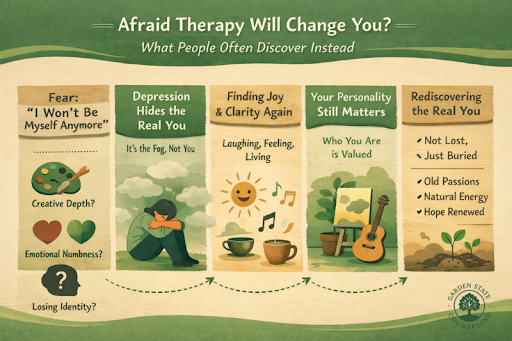
Depression can make it seem like your identity has permanently changed.
But more often, people discover that who they are was never gone just hidden under the weight of what they were carrying.
Call 201-632-5716 or visit our depression therapy services to learn more about our therapy, depression therapy services in New Jersey.