



I didn’t walk back in the same person who left.
And that’s what made it feel different.
The shame was louder, sure. But so was the truth.
The First Time, I Was Trying to Prove Something
The first time I went in, I wanted to “get it right.”
Say the right things. Feel the right breakthroughs. Leave as a better version of myself.
But underneath all that effort, I was still holding something back.
I wasn’t lying to anyone else. Just to myself.
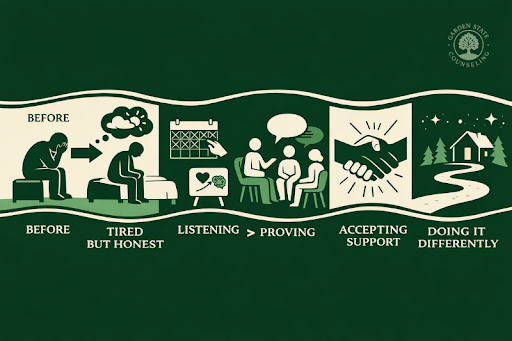
The Second Time, I Was Tired in a More Honest Way
Relapse doesn’t just hurt—it humbles you in a way nothing else does.
That second admission didn’t come with big declarations. No speeches. No promises.
Just a quiet thought:
“I can’t keep doing this my way.”
That kind of honesty hits different. It’s not dramatic—it’s real.
And if you’re here right now, you probably know exactly what I mean.
I Stopped Trying to Graduate and Started Trying to Listen
The first time, I treated it like something to complete.
The second time, I treated it like something to understand.
I listened more. Talked less.
I stopped comparing my progress to everyone else’s.
And for the first time, I let things actually land.
Not just the hopeful parts—but the uncomfortable ones too.
The People Around Me Felt Different—Because I Was
Same kinds of groups. Same structure.
But the way I showed up changed everything.
I wasn’t scanning the room anymore, wondering if I belonged.
I knew I did.
Because I had already lived what happens when you don’t take it seriously enough.
There’s a strange kind of peace in that realization.
Not a happy one—but a steady one.
I Finally Understood What “Support” Actually Meant
Before, I thought support meant people helping me stay sober.
The second time, I realized it meant letting people actually see me.
Not the cleaned-up version. Not the version with a plan.
The real one.
That’s where something started to shift.
If you’re considering going back, this is worth remembering—
it’s not about doing it perfectly. It’s about doing it honestly.
If you’re exploring structured options again, you can learn more about live-in treatment options that meet you where you are now—not where you were before.
The Shame Didn’t Go Away But It Stopped Controlling Me
Let’s be real. The shame is there.
You think about the time you had. The people you told. The hope you felt.
And yeah—it stings.
But here’s the part no one says enough:
That shame doesn’t disqualify you.
It actually means you care.
And caring is still something to build on.
What I Wish Someone Told Me Before I Came Back
You’re not starting from zero.
You’re walking in with experience. With awareness. With proof that this is hard—and that you tried.
That matters more than you think.
“I thought going back meant I failed. Turns out, it meant I wasn’t done yet.”
– Alumni, shared in group
You’re Allowed to Do This Differently
Maybe slower.
Maybe more open.
Maybe without trying to impress anyone.
That’s not weakness.
That’s growth trying to happen in a quieter way.
And if you’re looking for support in New Jersey, there are real people ready to meet you there—without judgment, without pressure, just steady help. You can explore support in New Jersey as a place to start again, differently this time.
You Didn’t Ruin It, You’re Still In It
Relapse doesn’t erase what you learned.
It just makes the next step more honest.
And sometimes, that honesty is exactly what changes everything.
Call 201201 632-5716 or visit our programs, residential treatment program services in to learn more.
And just to say this—if you’re the one writing content like this, helping someone feel less alone in a moment like this… it matters more than you probably hear. Keep going.