


You can feel it before you can explain it. Something has shifted. Your child isn’t just overwhelmed—they’re unraveling in ways you don’t recognize. And you’re left asking a quiet, heavy question: How bad is this, really?
At Garden State Counseling Center’s approach to anxiety support, we meet families in exactly this moment when concern turns into urgency, and you need more than reassurance.
It Doesn’t Always Look Like Panic
Severe anxiety in young adults doesn’t always show up as obvious distress. Sometimes it’s withdrawal. Missed classes. A door that stays closed longer each day.
Other times, it’s irritability, exhaustion, or a constant edge that never settles.
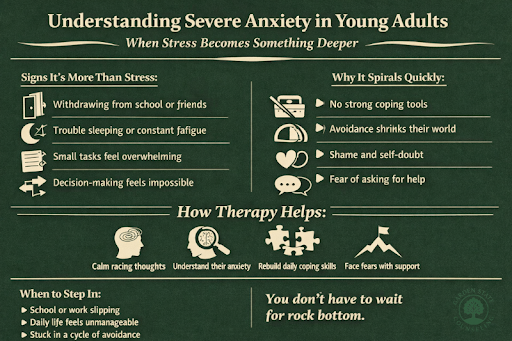
You might notice:
- They can’t make simple decisions anymore
- Sleep is off—too much or barely any
- Small tasks feel impossible
- They seem overwhelmed by things they used to handle
It’s confusing because it doesn’t always look like what people expect anxiety to be.
But you’re not imagining it. Something deeper is happening.
The Fear Parents Don’t Always Say Out Loud
Most parents we speak to carry a quiet fear they don’t want to name:
“What if I’m losing them?”
Not physically. But emotionally. Mentally. The version of them you knew feels out of reach.
You may wonder if you missed signs. If you pushed too hard. Or not enough.
Let’s be clear about one thing:
This is not a failure of parenting.
Anxiety at this level isn’t about willpower or upbringing. It’s something that needs real, structured support.
Why Things Can Escalate So Quickly
Young adulthood is already a fragile transition. Identity, pressure, independence—it all stacks up.
When anxiety takes hold, it can spiral fast because:
- They don’t yet have coping tools that actually work
- Avoidance starts to shrink their world
- Shame builds quietly in the background
- They may not know how to ask for help—or resist it entirely
What looks like “shutting down” is often someone internally overwhelmed beyond their capacity.
Like a phone with too many apps open—it doesn’t just slow down. It freezes.
What Real Support Actually Does
This is where support changes things—not overnight, but meaningfully.
The right kind of care helps young adults:
- Slow their thoughts enough to breathe again
- Understand what’s happening inside them (without judgment)
- Rebuild tolerance for everyday stress
- Learn how to face—not avoid—what feels overwhelming
It’s not about “fixing” them.
It’s about helping them come back to themselves, piece by piece.
And just as importantly—it gives you a clearer role as a parent. Not guessing. Not walking on eggshells. But understanding how to support without losing yourself in the process.
🚩 Signs It May Be Time to Step In
You don’t need to wait for a breaking point.
If you’re seeing patterns like these, it may be time for more structured help:
- They’ve stopped engaging with school, work, or relationships
- Anxiety is interfering with basic daily functioning
- They seem stuck in cycles they can’t break on their own
- You feel like nothing you’re doing is helping anymore
That last one matters.
Because parents often wait too long, hoping things will pass.
Sometimes they don’t. But they can change—with the right support.
You Don’t Have to Navigate This Alone
There’s a difference between hoping things improve… and having a plan.
Families who reach out often say the same thing afterward:
“I wish we had done this sooner.”
If you’re looking for treatment options in New Jersey, there are ways to move forward that don’t feel overwhelming or rushed—just steady, thoughtful, and grounded in what your child actually needs.
A Way Forward That Feels Possible
Right now, everything might feel uncertain.
But this moment—this realization—is also a turning point.
With the right support, young adults don’t just stabilize. They begin to reconnect. To re-engage. To feel like themselves again.
And you get to exhale, even just a little.
Call 201-632-5716 or explore our therapy, anxiety therapy services to learn more about how we support families like yours.