



I’ve been sober long enough to know this part doesn’t get talked about enough.
Getting clean changes you.
It doesn’t automatically change your family.
And that realization can hit harder than early recovery ever did.
If you went through alcohol addiction treatment and did the work, therapy, groups, amends, boundaries, you probably expected things at home to feel different too.
Sometimes they do.
Sometimes they don’t.
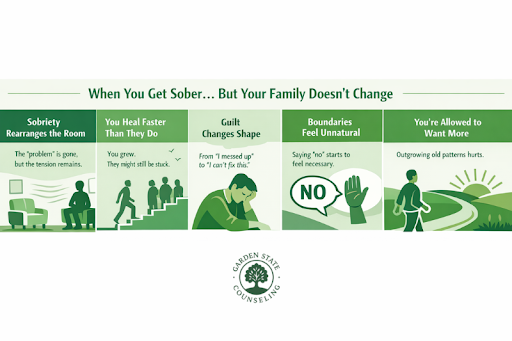
Sobriety Rearranges the Room
When you stop drinking, the system shifts.
The “problem” isn’t acting like the problem anymore.
The late-night chaos stops. The excuses stop. The emotional explosions slow down.
But families are systems. And systems like equilibrium, even unhealthy ones.
If you were the scapegoat, the mess, the unpredictable one… your sobriety can leave a vacuum. And not everyone knows what to do with that space.
Sometimes someone else steps into the chaos.
Sometimes tension just floats there, unspoken.
No one warned us about that part.
You Heal Faster Than the Dynamic
Treatment helps you see things clearly.
You learn about codependency. Avoidance. Control. Emotional immaturity.
You start noticing patterns that were invisible before.
And then you go home.
Now you’re the one trying to have direct conversations. You’re setting boundaries. You’re not taking the bait.
That growth can feel lonely.
Because the truth is your recovery doesn’t automatically enroll your family in theirs.
The Guilt Doesn’t Disappear, It Changes Shape
In early sobriety, guilt is loud and obvious.
Later? It’s quieter. More complicated.
You might feel guilty for outgrowing certain conversations.
For not rescuing.
For saying no.
There’s a strange grief in realizing you were the glue and sometimes the distraction, that kept deeper family issues buried.
Sobriety shines light in corners that were easier to ignore when you were drinking.
“Is This All There Is?”
Here’s the part long-term alumni don’t say out loud:
Sometimes you get sober… and then you feel emotionally flat in your family.
You’re proud of your time. You’re grateful.
But something feels off.
You might be sitting at a holiday dinner thinking,
I did the hardest thing of my life. Why does this still feel so small?
That’s not failure.
That’s awareness.
Growth creates distance before it creates connection.
Boundaries Change the Script
The first time you don’t argue back.
The first time you leave early.
The first time you say, “I’m not discussing that.”
It feels unnatural.
It might even feel selfish.
But it’s actually the most adult move in the room.
Family dynamics don’t shift because you explain them perfectly.
They shift because you consistently behave differently.
And consistency is boring.
And powerful.
You’re Allowed to Want More
Long-term sobriety isn’t just about not drinking. It’s about building a life that feels honest.
If your family relationships still feel tense, strained, or emotionally shallow, that doesn’t mean recovery “didn’t work.”
It might mean you’ve outgrown certain patterns.
And sometimes that requires deeper support individual therapy, family counseling, or even revisiting structured care if old triggers are creeping back in.
For some alumni, returning to support even something like multi-day weekly treatment or a therapeutic reset doesn’t mean regression. It means refinement.
If you need deeper care in New Jersey, there are options that respect your sobriety while helping you untangle the relational part that lingers.
Because here’s the truth no one says:
Sobriety fixes the substance.
It exposes the system.
And working on the system is advanced recovery work.
Not everyone is ready for that.
But if you’re reading this, you probably are.
If you’re re-evaluating your next step or wondering whether it’s time to deepen your support, Garden State Counseling Center offers grounded, real-world alcohol addiction treatment designed for people who are serious about long-term change not just short-term sobriety.
Call 201-632-5716 or visit our page to learn more about our alcohol addiction treatment services in New Jersey.