



They don’t usually look like they’re falling apart.
They show up on time. Make eye contact. Smile on cue. They’re thoughtful. Grateful. Even self-aware. And they’re often the ones who say, “I’m fine,” in a way that sounds so convincing, even therapists pause.
But in Cognitive Behavioral Therapy (CBT), things change—not in session one, not always in session five—but eventually, they slow down. And when they do, the unraveling begins. Quietly. Intentionally. Often in whispers, not breakdowns.
At Garden State Counseling Center, we work with many high-functioning clients—especially those whose addictions, perfectionism, or anxiety go unnoticed for years. If you’re someone who “keeps it all together” while quietly falling apart inside, CBT may be your turning point. Not because you break—but because, finally, you don’t have to perform.
We offer CBT therapy in Paramus, New Jersey for high-achievers, high-hiders, and people who aren’t used to being seen when they’re struggling.
The Cost of Holding It All Together
High-functioning doesn’t mean healthy. It means you’re good at compensating. You’re fast. Capable. Smart enough to outthink your pain, productive enough to mask it.
But here’s the secret: just because you can carry it all doesn’t mean you should.
In CBT, the cost of that emotional labor comes to the surface:
- You notice how you push through exhaustion and call it “normal.”
- You track thoughts like “If I slow down, I’ll lose everything.”
- You realize your “calm” is just suppression with better branding.
High-functioning clients rarely ask for help until the structure starts cracking—missed deadlines, short fuses, numbing more than usual, or that creeping fear: What happens if I stop moving?
CBT slows you down—not to break you—but to let you rest. To let you listen. To help you notice what’s been running on autopilot.
CBT Helps You Hear What You’ve Been Ignoring
CBT teaches you how to examine the thoughts that run in the background—quiet scripts that dictate behavior without your consent. For high-functioning people, those thoughts are often perfectionistic, fear-based, or shame-driven.
Some common ones:
- “If I don’t do it perfectly, I’ve failed.”
- “I can’t ask for help—I’ll look weak.”
- “If I stop drinking, I’ll feel everything.”
CBT doesn’t shame you for these thoughts. It meets you there—with curiosity, not judgment. Your therapist helps you slow the process, untangle the thought loops, and build space between trigger and reaction.
And often, that’s when the grief hits. The sadness of how long you’ve been in survival mode. The pain of what you’ve ignored. The exhaustion you’ve learned to normalize.
What Slowing Down Actually Looks Like in CBT
It’s not dramatic. It’s not even always emotional. Sometimes, it’s a moment where you pause mid-sentence and say, “Wait—I’ve never noticed I say that to myself every day.”
Other times, it’s:
- Choosing not to work through the weekend—and sitting with the discomfort that brings.
- Skipping the third drink and noticing what anxiety fills the space.
- Saying “I don’t know” out loud, and realizing you don’t have to.
Slowing down in CBT isn’t about doing less. It’s about noticing more.
Your therapist might help you:
- Track internal rules you didn’t know you were following
- Examine what “success” costs you emotionally
- Interrupt compulsive patterns before they escalate
CBT offers structure, but it also allows for slowness. For the first time, you get to stop performing and just be. That alone is its own kind of healing.
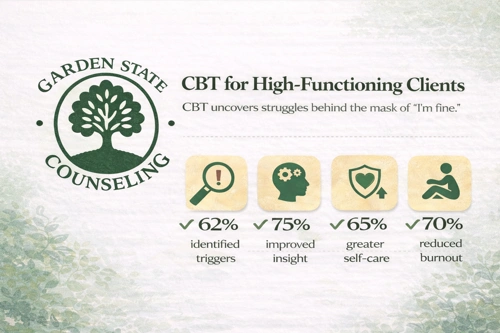
Addiction Can Hide Behind Achievement
We see it all the time. The well-dressed executive who drinks every night to sleep. The parent who hosts the PTA and then panics in silence at 2 a.m. The artist who’s brilliant—and constantly running from their own mind.
High-functioning addiction is real. It’s protected by your success. It’s minimized by those around you—“You’re fine! You’re doing great!”
But in CBT, we don’t look at your performance—we look at your patterns.
If you’re overusing alcohol, substances, sex, work, control, or perfectionism to escape emotional discomfort, CBT can help you face it—slowly, safely, with structure and support.
You don’t need to hit rock bottom. You just need to stop waiting for things to break completely before you allow yourself to heal.
The Shift: From Self-Criticism to Self-Study
High-functioning clients are often their own worst critics. You know how to analyze. To self-blame. To overcorrect.
CBT redirects that energy—from self-attack to self-study.
It’s not, “What’s wrong with me?”
It’s, “What is this pattern protecting me from?”
You learn to see your behaviors not as character flaws, but as survival strategies—some outdated, some no longer useful, all worth understanding.
This shift changes everything.
Suddenly, therapy isn’t about “fixing” yourself—it’s about reclaiming parts you’ve ignored. It’s about building new habits with intention, not fear. And it’s about finally trusting that you don’t have to earn rest, safety, or care.
CBT for the Person Who’s Always in Control
If you’re reading this and thinking, “Yeah, but I’ve got it handled”—that might be the strongest clue of all.
Control feels like a lifeline. But when it becomes a cage, CBT offers a key—not to throw away control, but to redefine it.
Real control isn’t about micromanaging your emotions or schedule. It’s about emotional flexibility. Choice. Clarity. Capacity.
CBT gives you tools to:
- Notice your reactions before they explode
- Redirect thoughts without repressing them
- Sit with discomfort without panic
- Rebuild trust with yourself, not your image
If you’re looking for CBT in Paterson, and Ridgewood we work with clients just like you—brilliant, burning out, and ready to do the deeper work.
FAQs: CBT for the High-Functioning and Hidden Struggles
Is CBT too surface-level if I’m dealing with addiction or deep emotional patterns?
Not at all. CBT is practical—but not shallow. It helps you address patterns that fuel addiction or emotional avoidance. It’s often the first layer in a deeper therapeutic journey.
What if I’ve been successful for years? Does CBT still apply?
Yes. Success doesn’t mean peace. Many high-functioning individuals carry invisible stress, self-loathing, or numbing habits. CBT helps you explore those without judgment.
Will I have to talk about things I’m not ready to face?
No. CBT moves at your pace. It starts with what’s happening now and builds capacity for deeper reflection over time.
How long before I feel a difference?
Some clients feel more aware after a few sessions. Others need a few months to notice change. But the work starts with one shift: slowing down and staying with yourself.
Do I have to stop drinking or working too much before I start CBT?
No. You can begin where you are. Your CBT therapist will help you explore behaviors without forcing change before you’re ready.
Call (201) 632 5716 to learn more about our Cognitive Behavioral Therapy in Paramus, New Jersey. This is a place where high-functioning doesn’t have to mean high-pressure—and where slowing down might be the bravest step you ever take.