


When your child relapses, the heartbreak is quiet and brutal.
You don’t always cry. You don’t always yell. Sometimes you just freeze—watching the same patterns unfold and wondering how this became your life again.
It’s not like the first time. The shock is gone. The grief hits lower, slower. You’re not scrambling for information anymore. You know the signs. You’ve read the books. You’ve done everything you were supposed to do. And still, they’re using again.
Maybe they promised they were done. Maybe they said, “It’s not like before.” Maybe they convinced you—for a while. And maybe now you’re scared that sending them back to treatment will feel like punishment, or proof that they’ve failed, or proof that you did.
But relapse doesn’t mean failure. It means something needs to be adjusted. And residential treatment isn’t a sentence—it’s a reset.
At Garden State Counseling Center, we offer a Residential Treatment Program in Hackensack, New Jersey that helps young adults and their families rebuild—after relapse, after confusion, and after the hope feels too heavy to hold alone.
Relapse Isn’t the Opposite of Recovery—It’s Often Part of It
This isn’t what you wanted. Not after the effort, the tears, the progress you saw.
But we need to be honest: relapse happens. And when it does, it’s not a personal failure. It’s a signal. A sign that something wasn’t ready, or safe, or supported enough.
Most people relapse because the conditions outside treatment don’t match the tools they’ve learned inside. They’re overwhelmed, emotionally unregulated, isolated, or struggling with shame.
That’s where residential treatment comes in—not to erase what they’ve learned, but to deepen it. To meet this new version of their struggle with a new level of support.
Why Going Back Isn’t “Starting Over”
One of the hardest parts for parents is watching their child walk back into treatment for the second—or third—time.
It feels like déjà vu. You question everything. Did we miss something? Should we have caught the signs sooner? Why didn’t the first time work?
But here’s the truth: many people don’t get it the first time. Not because they weren’t trying. Not because they didn’t care. But because recovery isn’t linear—and neither is readiness.
What changes the second time around?
- They know what to expect.
- They’re often more honest.
- They come in with real questions—not just compliance.
- And we meet them with that same honesty, not shame.
Reset doesn’t mean rewind. It means rebuild.
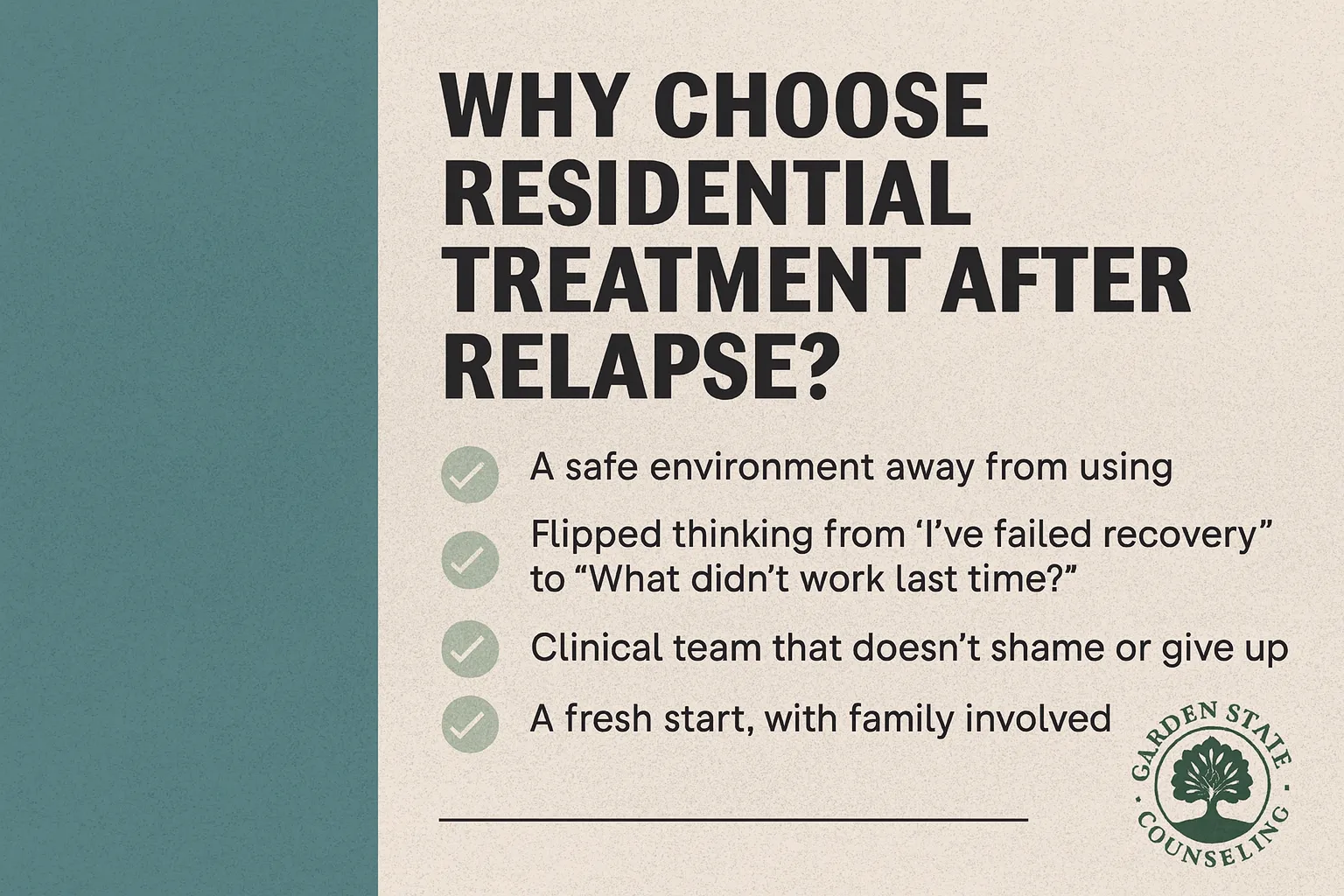
What Happens Inside a Residential Treatment Program After Relapse?
It’s not about locking your child away. It’s not about discipline or forced transformation.
Here’s what it is about:
1. Medical and emotional stabilization. If they’re actively using, we help them safely detox, re-regulate their body, and assess any urgent risks (physical, psychiatric, or emotional).
2. Deep clinical assessment. We don’t just treat the symptoms. We explore the roots—trauma, mental health, identity, family dynamics, and more. Especially what may have contributed to the relapse.
3. Peer support that reduces shame. Your child will meet others who have also relapsed. That matters. Because feeling alone—or “behind”—keeps people stuck.
4. Skill-building for long-term resilience. Not just how to avoid substances, but how to manage cravings, rebuild routines, ask for help, and hold boundaries.
5. Family involvement. You’re not sidelined. We include family therapy, education, and communication work—because you’re part of the healing, too.
Your Child Isn’t Being Sent Away. They’re Being Given Space to Heal.
When you’re in the thick of relapse, home can become a battlefield.
Every interaction is tense. Every day is a guessing game: Will they use today? Will they disappear? Will this be the day something goes too far?
Sending your child to a Residential Treatment Program in Yonkers, NY gives them the structured space to get quiet, get clear, and get real.
It also gives you space to breathe. To sleep. To cry without hiding. To feel what you need to feel without walking on eggshells.
That’s not abandonment. That’s sustainability.
Your Love Isn’t Measured by Proximity—It’s Measured by Boundaries
One of the most loving things you can do is recognize when your home isn’t the safest place for recovery to begin again.
That doesn’t make you a bad parent. It makes you a brave one.
When your child is using again, especially in your home, your nervous system is constantly in overdrive. So is theirs. It’s hard to heal in that space.
A structured, compassionate treatment setting can become the container they need to remember who they are without substances. And you can become the parent who still shows up—but from a place of steadiness, not crisis.
They Haven’t Failed. They’ve Just Hit a Wall They Can’t Climb Alone
You may be angry. You may be heartbroken. You may be numb. All of those are valid.
But underneath whatever your child is doing or saying right now, there’s someone who once wanted to get better. That part of them may be buried. It may be scared. But it’s not gone.
In treatment, we help them find that part again.
And we help you find the version of your relationship that doesn’t revolve around monitoring, rescuing, or fearing the worst.
FAQs: Residential Treatment After Relapse — What Parents Ask
Q: What if my child refuses to go?
Resistance is common, especially when someone feels ashamed or hopeless. We can help coach you through conversations and, in some cases, recommend intervention support. We believe in consent-based care whenever possible—but also know when safety has to come first.
Q: How is this different from the first time they went?
We treat second-time admissions with fresh eyes. That includes a new assessment, updated treatment goals, and focused relapse prevention. We also work with insights from the first round—what worked, what didn’t, and what your child needs now.
Q: What role do parents play during the program?
You’re not left out. We offer family sessions, check-ins, and education to help you understand relapse, rebuild communication, and create a supportive home environment for discharge.
Q: Can my child still go to school or work after treatment?
Yes. After residential, we help build a transition plan that may include intensive outpatient care, sober living, or part-time reentry into work or school—based on clinical readiness.
Q: What if I feel guilty for sending them back?
Guilt is normal. But please know this: you are not punishing them. You’re giving them access to care, clarity, and connection. That’s love in action.
Q: How long is the program?
Length of stay depends on clinical need but typically ranges from 30 to 60 days. We prioritize stabilization, emotional safety, and clear discharge planning so your child doesn’t feel rushed—or stuck.
You Didn’t Cause This—But You Can Help Change the Ending
Relapse doesn’t mean the story is over. It means the next chapter needs more support.
You don’t have to wait for rock bottom. You don’t have to carry the fear alone. And you don’t have to know exactly what to do. That’s what we’re here for.
At Garden State Counseling Center, we see your child as more than their choices. And we see you as more than your exhaustion.
We help young adults find their footing—and help parents reclaim hope that feels real.
You Don’t Have to Do This Alone
If your child has relapsed, help is still within reach. Our Residential Treatment Program is here to provide a safe, compassionate reset—not a punishment, but a real path forward. Call (201) 632 5716 or visit our Residential Treatment Program page to learn how Garden State Counseling Center supports families in Paramus, New Jersey through healing that lasts.