



There’s something strange about this time of year.
You can be surrounded by beauty—twinkling lights, songs you grew up with, the smell of pine or cinnamon or something warm—and still feel… hollow.
It doesn’t mean you’re doing anything wrong. It doesn’t mean you’re broken. But if you’ve been through treatment, done the work, and now find yourself in this quiet, disconnected place, it can feel confusing. Lonely. Even a little shameful.
Because when you’ve spent time rebuilding your life, learning tools, holding onto hope—feeling flat afterward can feel like failure. But it’s not.
It’s just another season. And sometimes, the most important part of recovery is knowing when to return to your roots. To revisit the strength you found in treatment—not because you’re in crisis, but because you remember how it helped you feel alive again.
At Garden State Counseling Center, our Residential Treatment Program is more than a beginning. It’s a foundation. And it’s still here for you—especially when the world feels a little too quiet.
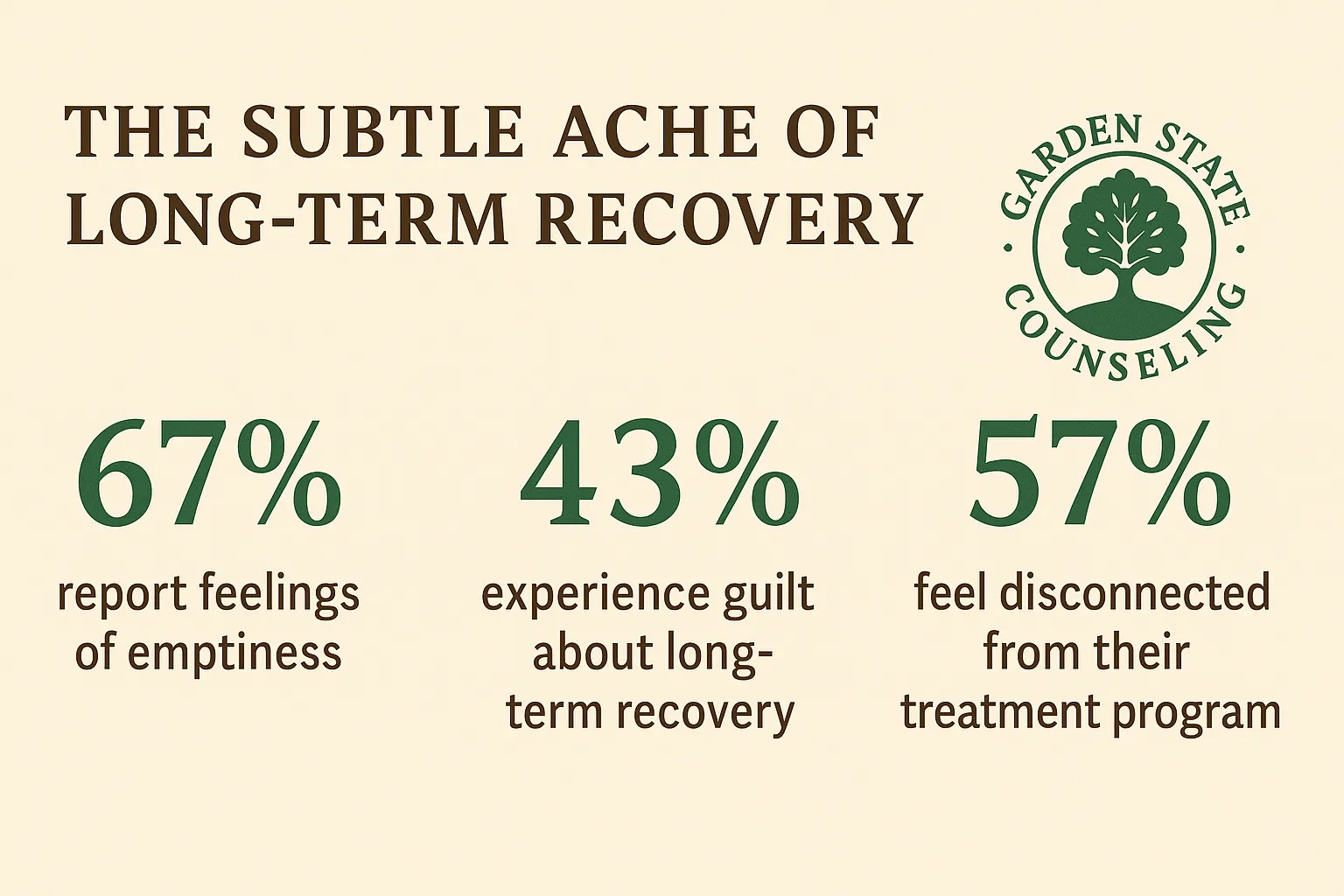
The Subtle Ache of Long-Term Recovery
Nobody talks enough about the middle.
We hear stories of rock bottom and of bright new beginnings. We hear about detox, day one, breakthroughs, and year-long milestones. But what about year two? Year four? Year eight?
What about the days that feel fine—but not full?
If you’ve been out of treatment for a while, you might be keeping up with life just fine. You’ve got the job. The routine. Maybe the family. Maybe the friends. Nothing’s “wrong.”
But something also isn’t quite right. You’re not spiraling. But you’re not lit up, either.
You’re existing. And for people who fought hard to come back to life, that can be a painful place to land.
You’re Not Ungrateful—You’re Just Disconnected
If you’ve found yourself thinking:
- Why does this feel so flat?
- I should feel more joy than this.
- I thought I’d be more okay by now.
You’re not alone.
There’s often guilt baked into long-term recovery. Like if we’re not beaming with gratitude all the time, we’re doing something wrong. But recovery isn’t a performance. You don’t owe the world brightness every day.
Sometimes, it’s enough to notice: I feel far away from myself.
And then, gently, start to find your way back.
The Strength You Built Is Still There
Maybe your time in our Residential Treatment Program Ridgewood, NJ feels far away.
Maybe it’s been months or years since you last walked through the doors or reread your discharge packet. Maybe the journal you kept then is collecting dust. Maybe the group photos are tucked in a drawer.
But your growth didn’t vanish.
You still carry the insight you earned. The honesty you practiced. The courage it took to look at your life and say, This isn’t how I want it to stay.
That strength doesn’t disappear just because you’re feeling flat. Sometimes it just needs a gentle nudge to resurface.
The Holidays Can Stir Up More Than We Expect
This time of year can bring beautiful things—connection, tradition, rest. But it can also stir up deep, quiet discomforts.
Memories that hurt. Expectations that feel heavy. Loneliness that doesn’t look dramatic, but lingers.
For many of us in recovery, the holidays highlight distance. Distance between who we were and who we are. Distance between the joy we “should” feel and the low hum of numbness underneath.
These aren’t signs of failure. They’re signals. Signals that you might need more care right now. Not punishment. Not shame. Just more care.
Reconnection Doesn’t Have to Mean Starting Over
One of the biggest myths we carry is that asking for help means starting from scratch.
But returning to care doesn’t mean you’ve undone your progress. It means you know how to find support. That’s growth, not regression.
Our Residential Treatment Program in Paterson, NJ has supported alumni through seasonal reengagements, short-term refreshers, alumni groups, and quiet check-ins. Some people come back for a few weeks. Others for a few days. Some just walk in to sit and remember who they were when they first started getting well.
It all counts. It all matters.
You don’t need to fall apart to return. You just have to feel ready to reconnect.
When Stability Isn’t Enough Anymore
Stability is a gift. But after a while, it can start to feel like a box.
You’re not in crisis. But you’re also not deeply connected to anything. And you miss that fire—the one you found when recovery was raw and real and alive.
That feeling can come back. But it usually doesn’t return through pushing yourself harder or pretending everything’s fine.
It returns through gentleness. Reflection. Community. Sometimes even through revisiting the practices and people who helped you rise in the first place.
That’s why we keep our doors open—for the people who left on solid ground, and one day realize: I want more than just “fine.”
What Reconnection Can Look Like
Here’s what it might look like to reach back toward that strength:
- Calling your old clinician, just to talk
- Joining an alumni group during the holidays
- Walking through the building and remembering how far you’ve come
- Spending a week in residential to reset, reflect, and feel again
- Re-reading your treatment journal or favorite quotes from group
There’s no wrong way to remember yourself. There’s just what works—and what helps you feel human again.
FAQs: Support for Long-Term Alumni Feeling Disconnected
Q: I’m not in crisis. Can I still return for support?
Yes. You don’t need to be in crisis to reconnect. Many alumni return during emotionally flat seasons—not because something’s wrong, but because they want to feel more connected again.
Q: What if I finished treatment years ago?
That’s okay. Whether you left six months ago or six years ago, we’re still here. You don’t “age out” of support. Your time with us is part of your story—and you’re always welcome back.
Q: Do I have to go through the whole residential program again?
Not unless you want to. We offer flexible reengagement options for alumni—short-term stays, outpatient groups, alumni workshops, and more. We’ll work with you to find what fits.
Q: I feel ashamed that I’m struggling again. What if people judge me?
We hear this a lot. But needing support again isn’t shameful—it’s a sign that you’re still paying attention to yourself. That’s something to be proud of. And no one here will judge you for being human.
Q: Can I just talk to someone before deciding anything?
Absolutely. You can call us anytime for a no-pressure conversation about what you’re feeling and what kind of support you might want—or not want. It’s okay to be unsure.
Let This Season Be a Soft Return, Not a Hard Reset
You don’t have to dive all the way back in. But if something in you is tugging—quietly asking for more—you’re allowed to listen.
This season doesn’t have to sparkle. But it can hold space for real things: reflection, reconnection, rest, and renewal.
You’re not back at the beginning. You’re just at a bend in the road. And the path forward might start by remembering the one place that helped you walk again.
Ready to Reconnect?
If the light feels dim this season, you don’t have to navigate it alone. Call (201) 632 5716 or visit our Residential Treatment Program page to learn how Garden State Counseling Center in Paramus, New Jersey, Hackensack, NJ, Paterson, NJ, White Plains, NY, welcomes alumni back—with gentleness, respect, and real support.